Search

Friday, May 1, 2020

ANALYSIS | SA airline industry in danger of collapse, no sign of state aid - Fin24

tetekrefil.blogspot.com

South African airlines have a vital role to play in enabling the economy to try and rise out of the coronavirus induced recession.

Yet, the country's airline industry itself is in danger of collapse due to flight bans since the start of the lockdown on 27 March, leading to zero revenues.

Although government has already announced various Covid-19 aid programmes, there has, so far, not been any indication of assistance specifically to enable the airline industry to survive.

Restricted air travel will only commence at lockdown Level 3, full domestic air travel at Level 2 and regional and international air travel at Level 1. Some airlines, like Comair and FlySafair, have already indicated that they will likely only be allowed to fly again by September, October or even November.

"We recognise that the primary objective is to prevent the virus from spreading, but the longer the airline industry is unable to fly, the more severe the risk becomes of loss of jobs and loss of airlines," warns Chris Zweigenthal, CEO of the Airlines Association of Southern Africa (AASA).

For him it is incorrect to blame the airline industry as spreading the virus as passengers had contracted the virus prior to travel and unfortunately travelled whilst carrying the virus.

"We believe the airline industry can provide very safe and reliable transport to get the economy going around the country and when borders open, we can get regional and international travel back on track."

AASA will continue to work with all stakeholders in order to make this possible.

He argues that, whilst airlines currently will fight to survive the pandemic, international airlines cannot simply step in to fill the void should local airlines not survive. While they are able to fly international flights to SA, foreign-owned companies are legally prohibited from flying domestic routes.

Before the start of the pandemic, the air transport and tourism industries in SA supported a total of about 472 000 jobs and contributed about R180 billion to GDP each year.

The International Air Transport Association (IATA) now estimates that in SA 252 000 jobs are at risk and the contribution to the SA economy could be reduced to R97 billion.

Iata CEO Alexandre de Juniac has been quite emphatic that governments should support all airlines, regardless of whether they are owned by a state, private-sector shareholders or any combination of the two.

Zweigenthal similarly believes that any Covid-19 airline aid – if any - should be given to all SA airlines, whether they are state-owned or not.

Aviation economist Joachim Vermooten also agrees, and adds that such government aid should be distributed pro rata according to an airline's market share, otherwise it will create a distortion to competition.

Not just airlines

Airports Company SA (ACSA) and the SA Civil Aviation Authority (SACAA) and the Air Traffic and Navigation Services (ATNS) would also most likely need Covid-19 assistance, he says.

Vermooten notes that airlines are very expensive to run. Even before the coronavirus pandemic and lockdown led to the grounding of airlines, it is estimated that South African Airways (SAA) incurred losses of about R6 billion a year.

"Without a few competitive airline networks, it is impossible to have a functional economy. Clear provision has to be made for competing airline networks to start post the coronavirus pandemic," says Vermooten.

SAA has been in business rescue since December last year. After a request for R10 billion was rejected by government on 10 April, the business rescue practitioners (BRPs) indicated that they do not have the funds to continue running the company beyond the end of April and might end up having no other option but to apply for liquidation.

A deadline for unions to accept a proposed employment termination agreement which would enable a structured winding down was set for 17:00 on Friday 1 May. Over the past 13 years SAA has incurred over R28bn in cumulative losses.

On Thursday, unions Numsa and SACAA filed an urgent application with the Labour Court in a bid to stop the BRPs' retrenchments at SAA. On Friday the Department of Public Enterprises issued a statement in which it describes a Leadership Compact between the department and unions with the vision of trying to restructure SAA into a "new airline". No mention has as yet been made of where the funding for such a process would be coming from.

Minister of Tourism Mmamoloko Kubayi-Ngubane said on Wednesday that government had reached no final decision yet on the fate of SAA, but she is hopeful that a decision may have been made by the end of June.

Low-cost airline Mango is a subsidiary of SAA. What its future holds, is as yet unclear. Whether it in itself is profitable or not is questionable, according to some industry experts.

State-owned regional airline SA Express, which was forced into business rescue by one of its creditors earlier this year, was placed in provisional liquidation on Tuesday when its BRPs threw in the towel after it could not provide a rescue plan which satisfied government and their request for further funds was also rejected.

JSE-listed Comair, the owner of kulula.com and the local operator for British Airways informed its shareholders on Thursday that it is lobbying the state for "special aid" through industry initiatives.

When SAA went into business rescue, it still owed Comair about R790 million from a R1.1 billion settlement in a competition case. It is unclear how much of that it will be able to recoup.

Comair started a restructuring process in March, which would include job losses.

Fin24 reported in March that regional airline SA Airlink plummeted to a loss of R365 million in November 2019 – compared to a profit of R84 million in September and R50 million in October – as a result of SAA withholding revenue from ticket sales when it went into business rescue.

Elmar Conradie, CEO of low-cost airline FlySafair, said during a recent webinar that the biggest impact is the uncertainty about when they will be able to fly again.

"We don't know what the demand will be once we start again. We would have to start small with a few flights a day, but would also have to be flexible to match demand if it suddenly picks up," said Conradie.

He would like to see some sort of leniency from government, like zero VAT and reduced aviation charges for a while. This would be to make it feasible to run flights on low load factors expected once flight bans are lifted.

Let's block ads! (Why?)


"danger" - Google News
May 02, 2020 at 12:00PM
https://ift.tt/2Ymq66h

ANALYSIS | SA airline industry in danger of collapse, no sign of state aid - Fin24
"danger" - Google News
https://ift.tt/3bVUlF0
https://ift.tt/3f9EULr

Coronavirus: Why so many people are dying in Belgium - BBC News

tetekrefil.blogspot.com

Belgium is the world's worst affected country when it comes to the coronavirus mortality rate.

That rate, unlike the total number of fatalities, is a measure of the number of deaths in relation to the size of population.

President Donald Trump pointed to a graph recently, displaying Belgium at the top and the US in seventh place, as a result of the number of deaths relative to population size.

He was suggesting the US was handling the pandemic more effectively.

Belgium has a population of 11.5 million. That means 66 people in every 100,000 have died from Covid-19. In the US, with a population of around 330 million, it's 19 in every 100,000, according to Johns Hopkins University data.

But those figures are "faulty comparisons" that have been "abused", argues Prof Steven Van Gucht, a Belgian virologist and government spokesman.

"That's the difference between public health science and political motivation," he explains. "That's purely inspired by showing how good you are doing, and it's wrong. We are actually reporting in a more correct way."

What's different about Belgium?

Belgian officials say they are counting in a way that no other country in the world is currently doing: counting deaths in hospitals and care homes, but including deaths in care homes that are suspected, not confirmed, as Covid-19 cases.

According to Belgium's latest official figures, out of 7,703 deaths, 53% have been in care homes.

Some 16% of deaths in care homes were tested positive for coronavirus. The rest are suspected.

That means more than 3,500 deaths have been counted as caused by Covid-19, but not confirmed.

How do they work it out?

"It's based on the assessment of the medical doctor, usually taking into account whether the coronavirus is present in the same care home," says Prof Van Gucht.

"For example: if you have one or two confirmed cases, then the week after you have 10 deaths in the same home based on similar symptoms."

Prof Steven Van Gucht

Getty Images

They are not tested in the lab, but it's reasonable to assume that these are also Covid-19 related

Prime Minister Sophie Wilmès recently suggested Belgium may be over-reporting the actual number of cases.

However, Prof Van Gucht says the real number of deaths may still be higher than they are reporting, as he believes they may still be missing a few cases.

Is it just down to counting?

Another factor is that many more people here put loved ones in care homes than elsewhere in Europe.

Only the Netherlands and Luxembourg have a higher rate of care home occupancy, relative to their populations.

Long-term care in Europe

Over-65s in care per 1,000 people

Officials also acknowledge mistakes were made at the beginning: poor preparation left care home staff lacking personal protective equipment (PPE). That allowed the virus to spread quickly, with devastating effect.

Now all nursing home staff are issued with masks and protective clothing, and nurses from hospitals and the military have been brought in to help.

Epidemiologists say they've found a "remarkable" observation in care homes, that around 10% of residents have been asymptomatic carriers of the virus and have built up an immunity. A small comfort, but of important scientific value.

How long has Belgium been in lockdown?

Since 18 March all non-essential business has been closed and, apart from emergency workers, people have been asked to stay at home.

Shopping is limited to one person per family. You can leave the house for medical reasons, to walk the dog, or for an hour's exercise with immediate family, or one other person, while maintaining social distancing of at least 1.5m (5ft).

Belgian police have been enforcing the lockdown, using drones in parks and fines for anyone breaking social distancing rules.

Checkpoints have been set up at the borders with Luxembourg, France and the Netherlands, allowing through only cross-border workers, or those with an urgent reason to enter Belgium.

Some cyclists have been fined after taking a ride into the Netherlands, then being stopped by Belgian police on the way back.

Neighbours with different lockdowns

All non-food shops have been closed too, which led to a bizarre incident in the neighbouring towns of Baarle Hertog and Baarle Nassau, where the border line runs through a bargain store called Zeemans.

The Dutch half of the shop is open, but the Belgian half has been taped off, with customers unable to get to the men's clothing section.

Unlike Belgium's policy, the Netherlands has what Prime Minister Mark Rutte described as an "intelligent lockdown", with florists, ironmongers, bakeries, clothes and toy stores remaining open.

There have been fewer deaths in the Netherlands, despite having a larger population. But unlike Belgium, the Netherlands does not count suspected Covid-19 deaths in care homes.

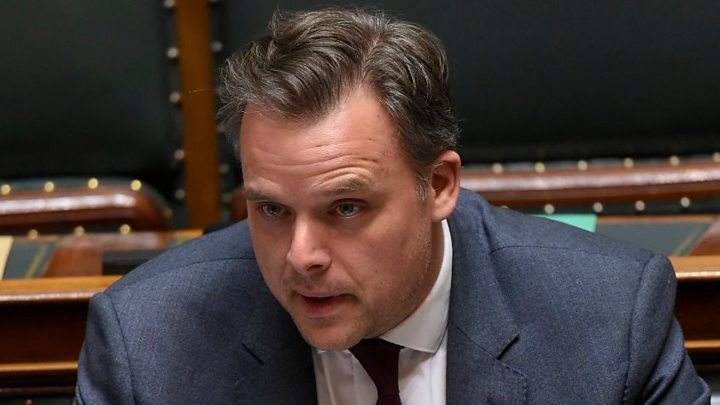
I asked the head of Belgium's Covid-19 taskforce, Minister Philippe De Backer, if he thought the Belgian confinement method was more effective than the more relaxed Dutch and Swedish approaches.

Media playback is unsupported on your device

He told me Swedes were renowned for following government advice, while it was "a bit more difficult in a country like Belgium". However, he was generally "impressed by how Belgians has dealt with the crisis".

What happens next?

Belgium will lift its lockdown gradually, in four phases. From Monday, fabric stores are being opened so people can buy material to make their own face masks. Masks will be mandatory on public transport.

Sport will be allowed, too, though no more than two people can play together.

All other shops will open from Monday 11 May. Schools will restart on 18 May, with a maximum of 10 students per class.

Cafes, restaurants and some tourist attractions will open after 8 June, if there has been no second spike in cases. Trips abroad may also be allowed in early June.

How is Belgium testing?

Testing for Covid-19 is being done on 10-20,000 people a day, with priority for emergency workers.

The taskforce has also finished screening all 210,000 residents and staff in care homes, discovering that 10% of people are infected. There are more than 500 care homes, and roughly half have had an outbreak.

Antibody tests to detect if people have had the virus will start in mid-May.

Will Belgium use tracking apps ?

Not in the short term. Taskforce head Philippe De Backer tells me it's not "feasible" at the moment, so they will concentrate on the laborious system of tracing manually.

"When people test positive, it activates a call centre, and our staff ask who they've been in contact with, and they will be contacted and may have to self-isolate."

Mr De Backer says use of an app requires at least 60% of the nation to take part voluntarily and he believes that is not realistic at the moment.

"I've seen reports in Austria where it's around 9-10%. So that means you need to do 90% of the tracking in another way," he says.

As Belgium gradually lifts its restrictions, 2,000 so-called "corona detectives" are being hired, to trace people who have been in contact with confirmed or suspected Covid-19 patients.

What has Belgium learned?

Belgian scientists have started to look at lessons that can be learned, including an analysis of why three cities have had the biggest concentration of cases: Charleroi in the south, and Hasselt and Sint-Truiden in the east.

Early indications suggest that local carnivals with big gatherings of people in March may have contributed, along with areas where second-generation Italian populations are high. In the case of Charleroi, experts are studying whether the spread was linked to issues of poverty and deprivation.

Belgian hospitals have been largely able to cope with the epidemic so far, with a 42% occupancy rate now, but some hospitals in Brussels have been overwhelmed, and have had to move patients elsewhere.

As the confinement here slowly ends, September is a worry for officials, as Prof Van Gucht makes clear.

"When all the schools are open again after the summer, that's when the virus risks spreading quickly again. That's when I'm more afraid, with winter coming too."

Let's block ads! (Why?)


"many" - Google News
May 02, 2020 at 07:19AM
https://ift.tt/35mkgTG

Coronavirus: Why so many people are dying in Belgium - BBC News
"many" - Google News
https://ift.tt/2OYUfnl
https://ift.tt/3f9EULr

COVID-19 Danger Prompts Call to Feds to Halt Cub Petting, Including at GW Zoo - PETA

tetekrefil.blogspot.com

After Big Cats Contract Virus at the Bronx Zoo, PETA Takes Action to Protect Vulnerable Cubs From Infected Humans

For Immediate Release:
May 1, 2020

Contact:
David Perle 202-483-7382

Wynnewood, Okla. – Following reports that big cats at the Bronx Zoo in New York tested positive for COVID-19, PETA has submitted a petition for rulemaking to the U.S. Department of Agriculture (USDA) calling on the agency to issue an emergency rule banning public encounters with big-cat cubs during the pandemic. The action comes as several states begin reopening and as notorious Tiger King exhibitor Jeff Lowe resumes operations at his roadside zoo, the Greater Wynnewood Exotic Animal Park, a.k.a. “G.W. Zoo.”

In the petition, PETA points out that stressful public handling puts vulnerable cubs—who’ve been prematurely separated from their mothers for use in the encounters and whose immune systems are not fully developed—at an increased risk of not only contracting the virus but also not recovering if infected.

“Tearing babies away from their mothers and passing them around as photo props is cruel in the best of times, but it may be deadly during a pandemic,” says PETA Foundation Deputy General Counsel for Captive Animal Law Enforcement Brittany Peet. “PETA is calling on officials to get ahead of the curve here and protect cubs from being put in harm’s way.”

PETA has longstanding campaigns against exploitative facilities that offer big-cat cub petting, including Lowe’s roadside zoo. Following a 2017 PETA complaint relating to his big-cat cub operation in Las Vegas, authorities raided his home, seized two big-cat cubs and a lemur, and cited him for failing to have the required licenses to operate a business and possess exotic animals in the city. Lowe was ordered to pay $10,000 and issued a “stay out of trouble” order. He apparently violated the terms of his plea agreement, and the case is still ongoing.

PETA—whose motto reads, in part, that “animals are not ours to use for entertainment” and which opposes speciesism, a human-supremacist worldview—requested that the USDA issue an interpretive rule making it clear that big-cat cub petting will be considered a violation of the federal Animal Welfare Act during the pandemic, if the agency refuses to promulgate a regulation.

For more information, please visit PETA.org.

Let's block ads! (Why?)


"danger" - Google News
May 02, 2020 at 02:55AM
https://ift.tt/2yiltiW

COVID-19 Danger Prompts Call to Feds to Halt Cub Petting, Including at GW Zoo - PETA
"danger" - Google News
https://ift.tt/3bVUlF0
https://ift.tt/3f9EULr
Julian Assange's life is in danger in London prison, partner says - New York Post

tetekrefil.blogspot.com

LONDON — The partner of WikiLeaks founder Julian Assange said on Friday his life is in danger while he is held in a London prison during the coronavirus lockdown.

Assange is fighting a request by the United States to extradite him to stand trial for conspiring to hack government computers and espionage, but hearings scheduled for later this month will not go ahead because of the lockdown.

“The life of my partner, Julian Assange, is at severe risk. He is on remand at HMP Belmarsh, and COVID-19 is spreading within its walls,” Stella Morris, who has two children with Assange, said in a statement.

“Julian needs to be released now. For him, for our family, and for the society we all want our children to grow up in.”

Morris, a lawyer, said last month that she met Assange in 2011 at the Ecuadorian embassy in London where he spent seven years avoiding arrest by British police.

Assange and WikiLeaks enraged the U.S. government a decade ago by publishing thousands of secret American documents. Assange’s supporters see him as a champion of free speech exposing abuses of power and hypocrisy by Washington.

A woman wears a face mask with a hashtag of support for WikiLeaks founder Julian Assange.
A woman wears a face mask with a hashtag of support for WikiLeaks founder Julian Assange.Reuters

The U.S. authorities say he is wanted not because he embarrassed them but because he endangered informants, dissidents and rights activists in several countries, including Iraq, Iran and Afghanistan by illegal actions.

Let's block ads! (Why?)


"danger" - Google News
May 02, 2020 at 08:25AM
https://ift.tt/3fcKtZC

Julian Assange's life is in danger in London prison, partner says - New York Post
"danger" - Google News
https://ift.tt/3bVUlF0
https://ift.tt/3f9EULr

Coronavirus: Why so many people are dying in Belgium - BBC News

A Texas-Size Reopening Has Many Wondering: Too Much or Not Enough? - The New York Times

tetekrefil.blogspot.com

HOUSTON — Texas pushed its way out of a statewide coronavirus lockdown on Friday, a wide-ranging reopening of restaurants, businesses and beaches in the midst of an ongoing outbreak that still left at least one local official hoping for even more.

“Who is the governor choosing as a winner or loser?” said Mark J. Keough, the chief executive in Montgomery County near Houston, who hinted this week that he was not going to accept the governor’s delay in opening businesses like bars, gyms, bowling alleys and salons. “I’m ready to start rolling here.”

Mr. Keough ultimately backed down, but the question of whether Texas is capable of doing anything halfway was much on the minds of mayors, residents and public health experts across the state as residents poured into malls and ordered pitchers of beer at Tex-Mex restaurants. How far would people who have been locked up for weeks push their newfound freedoms? How seriously would employers, workers and customers follow protocols about masks and distance?

Was it too soon?

Only a day earlier, the state reported its highest single-day death toll from the coronavirus, with 50 new fatalities. Dallas County reported 179 new cases, its highest so far, and for the first time exceeded 100 deaths. In Houston’s Harris County, the virus has spread in the sheriff’s office and at the county jail, infecting 238 sheriff’s employees and 411 inmates.

“What I say to my family members I’m saying to the people in this city: Be very, very cautious as you move forward,” Mayor Sylvester Turner of Houston told reporters this week. “Because as long as we’re reporting new cases, and as long as we’re reporting people who are dying, and as long as we can’t tell you that this virus is out of here, then you need to be very, very, very careful.”

The largest Republican-led state in the country is embarking down a politically charged path fraught with uncertainty and public health risks. The state ended its stay-at-home order weeks before some of the benchmark epidemiological models suggested doing so and shifted its focus to restoring a $1.8 trillion economy that has suffered from both the spread of the virus and plummeting oil prices.

The forecast for San Antonio is just one example of the risks ahead. If the state were to keep its stay-at-home orders in place, it would have about 1,800 coronavirus cases by Aug. 27, according to models by Juan B. Gutiérrez, a mathematical biologist at the University of Texas at San Antonio. If social distancing is reduced, the models suggest, the city could see 7,400 cases.

In San Antonio, waiters wearing face masks and gloves served plates of tacos to dine-in patrons seated at widely spaced tables. In Houston, the Galleria mall opened its doors from 11 a.m. to 7 p.m. but kept its playgrounds and water fountains shut. From border-city malls to small-town fast-food restaurants, from suburban barbecue joints to the Texas Chili Parlor in the shadow of the Capitol dome in Austin, people shopped, dined and mingled — all in the hope that they had already seen the worst of a pandemic that has infected 29,000 Texans and killed more than 800.

The rules require restaurants, movie theaters and retail shops to limit their capacity to 25 percent of their listed occupancy. In two weeks, if there has been no surge in coronavirus cases, capacity can expand to 50 percent and additional businesses, including those Mr. Keough in Montgomery County would like to see open, can resume operations.

The top infectious-disease experts in the state have been split on the partial reopening, with some saying that the scale of the state’s testing and contact-tracing system is still inadequate. They point to models developed by the Institute for Health Metrics and Evaluation, or I.H.M.E., which caution that the state should wait until mid-June to relax social distancing.

“It’s certainly too soon on the basis of what the I.H.M.E. models say,” said Dr. Peter Hotez, dean of the National School of Tropical Medicine at Baylor College of Medicine in Houston and a member of a state task force that advises the governor on infectious-disease preparedness. “There’s not a Covid-19 health system in place that’s commensurate with the economic recovery plans, and the risk is high that this virus will return later in the summer or fall.”

Dr. Hotez and other experts had a host of concerns as the state reopened. They said the two-week period for tracking any flare-ups after Friday’s initial reopening was not long enough, and needed to be up to four weeks. They particularly questioned allowing movie theaters to reopen, allowing people to sit for more than two hours in a closed space with air-conditioners recirculating air.

Other infectious-disease experts said Mr. Abbott’s reopening was an imperfect but prudent plan, and said the state could face equally dire social and public health impacts from an extended lockdown, including high rates of suicides, substance abuse and domestic violence.

“There isn’t a perfect game plan out there that’s evidence-based and proven for reopening a society in the midst of a pandemic,” said Dr. David L. Lakey, a former Texas health commissioner who helped oversee the Ebola crisis in Dallas in 2014 and now serves as the chief medical officer for the University of Texas System.

“This is on the more aggressive side of opening things up,” he said. “Is it wrong or not? I don’t know. It’s a judgment call. It’s going to need to be watched closely, with the ability to take a step backward if it looks like it’s moving faster than thought.”

Dr. Mark McClellan, a former commissioner of the U.S. Food and Drug Administration who is one of three chief medical advisers assisting the governor and state health officials, said Texas was ready to reopen in the measured way Mr. Abbott had laid out.

“We’re going to be living with this virus for quite awhile, so we need to figure out ways to get back out,” said Dr. McClellan, a physician and an economist at Duke University.

The reopening was a complex, muddled and scattershot endeavor in the second-largest state by both area and population. Mr. Abbott’s move superseded all local orders, angering many city and county leaders and adding to the confusion.

A Houston strip club planned to reopen as a restaurant with “featured entertainers.” Some restaurants required patrons to wear face masks, making eating and drinking a significant conundrum. James B. White, the owner of the Broken Spoke, a honky-tonk in Austin, was preparing to reopen on Friday — until the Alcoholic Beverage Commission reminded him that his establishment sells more alcohol than food and qualifies as a bar and not a restaurant. He called off the reopening.

In a state often defined by division — red versus blue, rural versus urban, black versus white, rich versus poor, immigrant versus native-born — the reopening gave Texans one more thing to be for or against. In Austin, critics of the reopening called for a boycott of reopened restaurants, while in the Houston suburb of Sugar Land, a Republican running for Congress, Kathaleen Wall, went on a celebratory four-stop “Back in Business” tour. The Texas Democratic Party dubbed it the “Back in Sickness” tour.

Many movie theaters, restaurants and other businesses kept their doors shut Friday, with some doing so because owners concluded that opening at a 25 percent limit did not make financial sense. Others said reopening so soon was too risky.

The celebrity chef Johnny Hernandez was reopening three of his seven restaurants in San Antonio and bringing back 40 furloughed employees, all of whom were being required to wear face masks and gloves. Patrons will be asked whether they have any symptoms, but Mr. Hernandez said he decided against checking diners for fevers as they enter.

At La Gloria Pearl, Mr. Hernandez’s flagship restaurant in the Pearl Brewery complex north of downtown, individual parties were limited to six, with a maximum of 28 indoor customers. He said he wanted the reopening of his restaurants to have an understated tone, in light of the pandemic.

“We want to be sensitive to what everyone’s going through,” Mr. Hernandez said.

The mayor of the border city of McAllen, Jim Darling, welcomed the reopening of the La Plaza Mall, which accounts for about 35 percent of the city’s sales tax revenue. The mall’s closure was one of the reasons the city had seen a $25 million virus-related loss in revenue.

Mr. Darling said the facility was going to operate “controlled entrances” and one-way foot traffic to prevent shoppers from congregating. Over all, he said, he thought malls could safely be part of Texas’ gradual re-emergence. “Considering everybody else that’s allowed to be open, I don’t have a problem with it,” he said.

Manny Fernandez reported from Houston and David Montgomery from Austin.

Let's block ads! (Why?)


"many" - Google News
May 02, 2020 at 06:34AM
https://ift.tt/2VRY1Sx

A Texas-Size Reopening Has Many Wondering: Too Much or Not Enough? - The New York Times
"many" - Google News
https://ift.tt/2OYUfnl
https://ift.tt/3f9EULr

Most Americans say COVID-19 has changed news reporting, but many are unsure how it's affected the industry - Pew Research Center

tetekrefil.blogspot.com
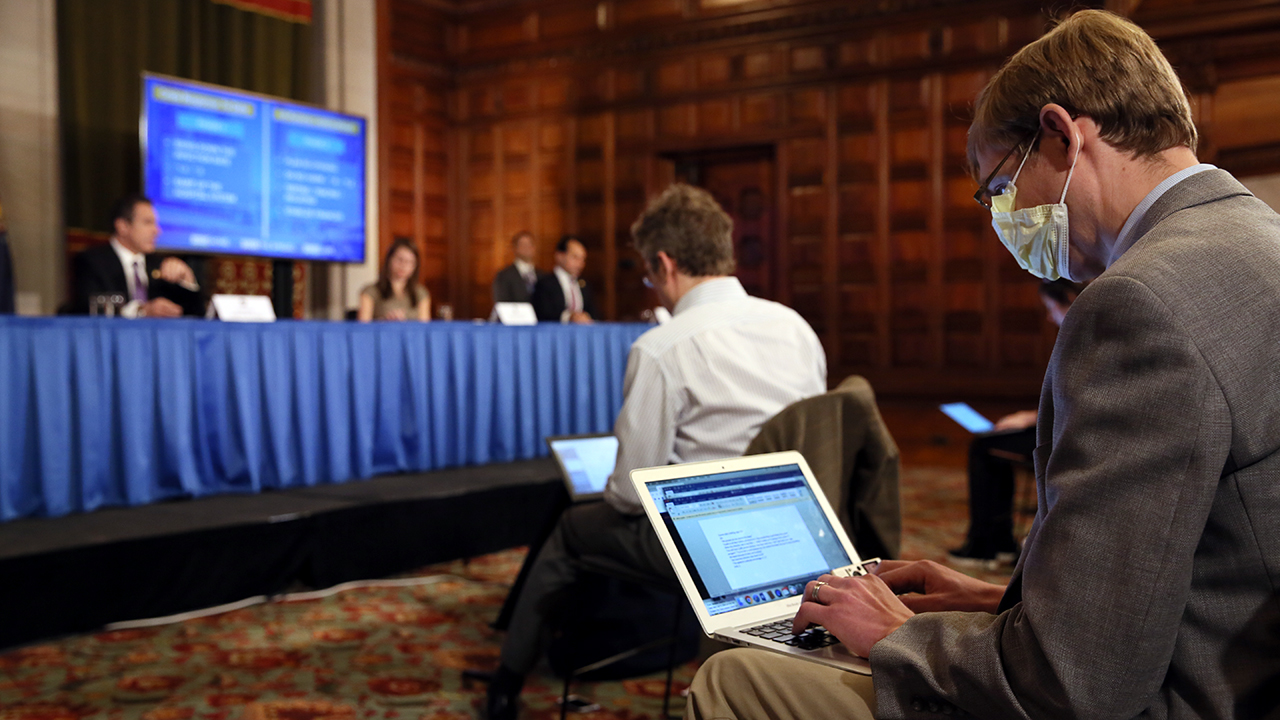
A reporter wearing a mask attends New York Governor Andrew Cuomo's press briefing about the coronavirus on April 17, 2020, in Albany, New York. (Matthew Cavanaugh/Getty Images)
A reporter wearing a mask attends New York Governor Andrew Cuomo’s press briefing about the coronavirus on April 17, 2020, in Albany, New York. (Matthew Cavanaugh/Getty Images)

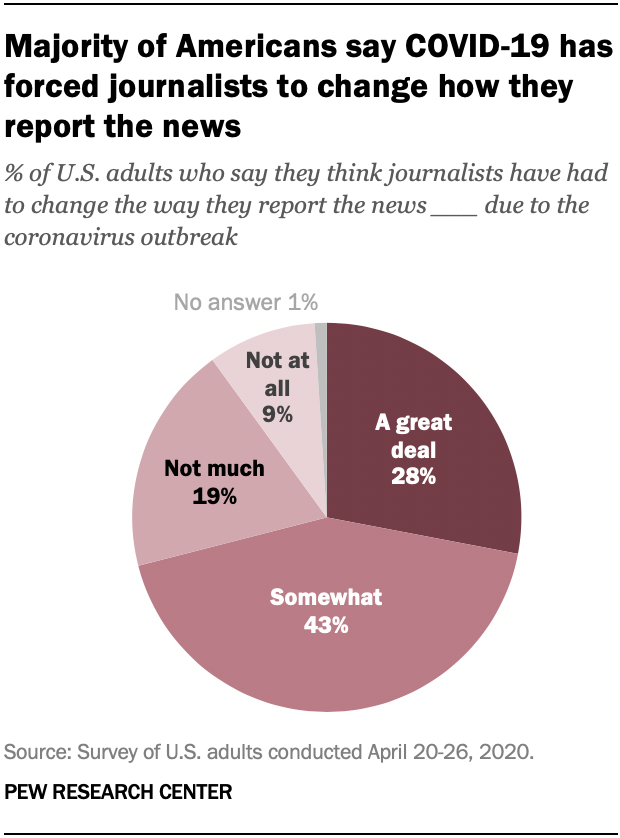
Majority of Americans say COVID-19 has forced journalists to change how they report the newsA solid majority of Americans say the COVID-19 pandemic has changed the way journalists report the news, but they are far less certain about how the outbreak is affecting news organizations’ bottom lines, according to an April 20-26 survey conducted among 10,139 U.S. adults as part of Pew Research Center’s Election News Pathways project.

About seven-in-ten U.S. adults (71%) say that as a result of the pandemic, journalists have had to change the way they report – either somewhat or a great deal. A total of 28% say journalists have not had to change how they report much or at all.

Despite reports of the outbreak’s economic toll on the news industry, the public’s sense about its impact on the financial well-being of most news organizations is far from clear. Roughly one-third (34%) of adults say they are not sure about that impact; about another third (32%) say the pandemic has hurt those organizations financially, either by a little or a lot. Equal shares say it has not had much impact financially (17%) or that it has helped news organizations’ bottom lines a little or a lot (17%).

How we did this

On both questions there are differences by political affiliation and ideology. Democrats and those who lean to the Democratic Party are more likely than Republicans and Republican leaners to say that COVID-19 has changed how journalists report the news. They are also more likely than Republicans to believe that the outbreak has done financial harm to most news organizations.

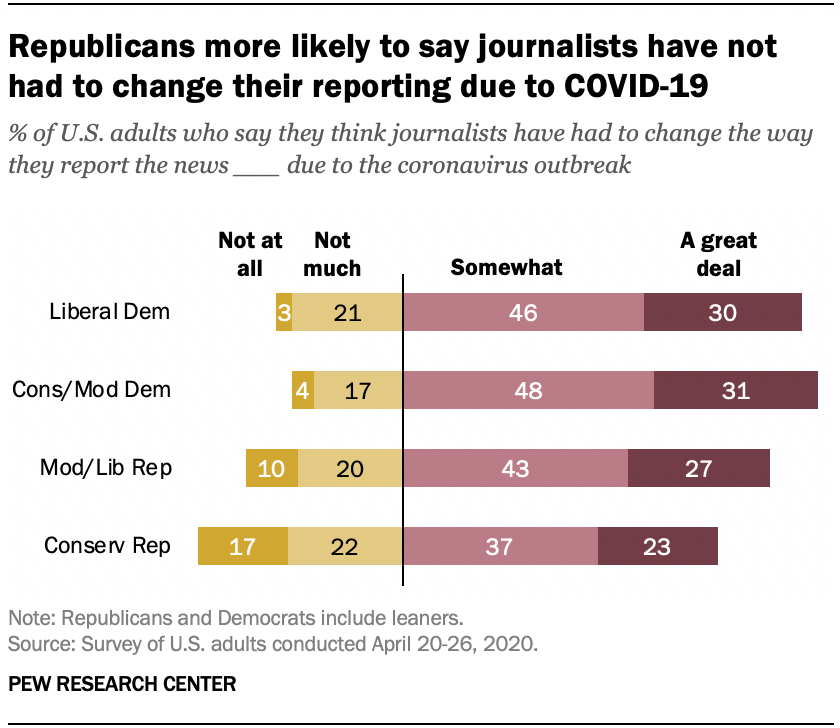
Republicans more likely to say journalists have not had to change their reporting due to COVID-19In all, 77% of Democrats and Democratic leaners say COVID-19 has changed the way journalists report the news, either somewhat or a great deal. That share decreases to 64% among Republicans and GOP leaners.

This pattern holds when examining the ideological segments within each party. Among conservative Republicans, for example, 60% say journalists have had to change how they report as a result of the COVID-19 outbreak. That compares with 78% of conservative and moderate Democrats and 76% of liberal Democrats who say the outbreak has spawned changes in reporting.

The question about the financial impact of the outbreak comes against a backdrop of cutbacks in an already beleaguered industry hit by additional advertising declines as COVID-19 shutters U.S. businesses. And, in a rare show of bipartisanship, more than 70 U.S. senators have asked the Office of Management and Budget to boost local news outlets with federal advertising dollars.

Still, the results of a 2019 Pew Research Center survey indicate that most Americans are unaware of the economic travails of the local news industry and that few contribute money to local news organizations themselves.

In the new survey, uncertainty about COVID-19’s impact on most news organizations’ finances is one area that crosses partisan and ideological lines. About one-third of all Democrats (34%) and Republicans (32%), including liberal Democrats (37%) and conservative Republicans (34%), say they are not sure of the impact.

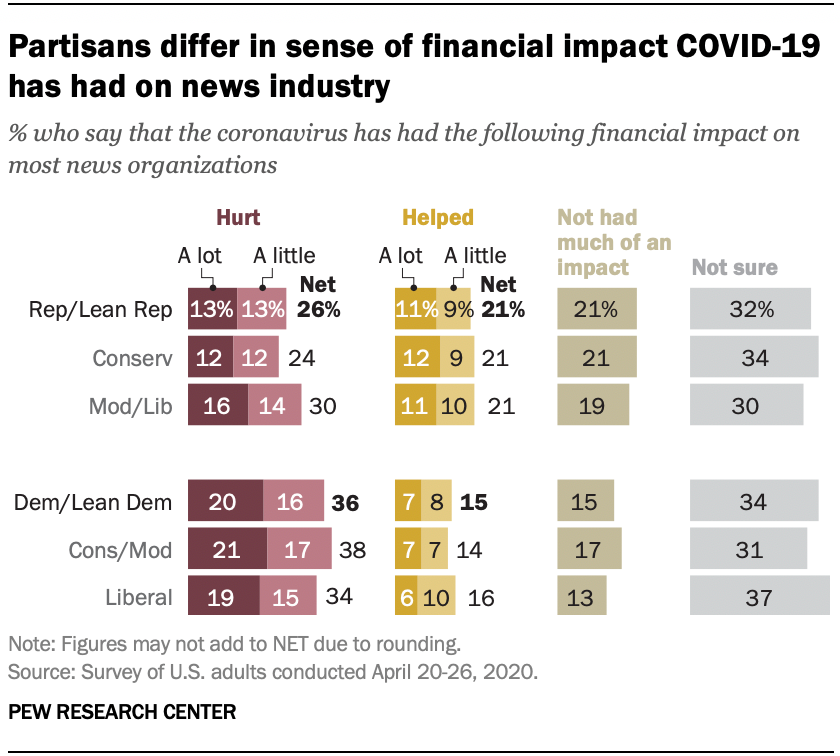
Republicans (21%) are somewhat more likely than Democrats (15%) to say that the pandemic has financially helped news organizations a little or a lot. The same pattern appears in the shares who say it has not had much economic impact (21% of Republicans say no impact vs. 15% of Democrats).

Partisans differ in sense of financial impact COVID-19 has had on news industryThe most significant partisan divergence is among those who say that the outbreak has hurt news organizations financially, either a little or a lot. Slightly more than a third (36%) of Democrats say those organizations have been adversely affected, compared with 26% of Republicans.

In the ideological segments of each party, 24% of conservative Republicans say the pandemic has done either a lot or a little bit of economic damage. That percentage increases to 30% among liberal and moderate Republicans, to 34% among liberal Democrats, and to 38% among conservative and moderate Democrats.

Aside from partisan differences, another factor that seems to affect responses to the questions about COVID-19’s impact on journalism is how closely people are following news about the outbreak.

For example, about seven-in-ten of those who say they are following news about the outbreak very closely (72%) or fairly closely (73%) say COVID-19 has changed how journalists report the news, either somewhat or by a great deal. That number decreases to 60% among those following that news not too closely or it not at all closely.

Similar differences emerge on the question of the pandemic’s financial impact on the news industry – particularly among those who say it has hurt news organizations economically.

More than a third (36%) of those following news of the pandemic very closely say it has done harm to the news industry’s bottom line, either by a little or a lot, followed by 29% of those who follow that news fairly closely. A quarter of those who say they follow COVID-19 news not too or not at all closely say the virus has financially hurt most news organizations.

Note: Here are the questions used for this report, along with responses, and its methodology. These findings are a part of Pew Research Center’s yearlong Election News Pathways project. You can find all the data from this report in the Pathways data tool, analyze it alongside other data points and even download the entire dataset.

Let's block ads! (Why?)


"many" - Google News
May 02, 2020 at 02:34AM
https://ift.tt/2YqMRpp

Most Americans say COVID-19 has changed news reporting, but many are unsure how it's affected the industry - Pew Research Center
"many" - Google News
https://ift.tt/2OYUfnl
https://ift.tt/3f9EULr