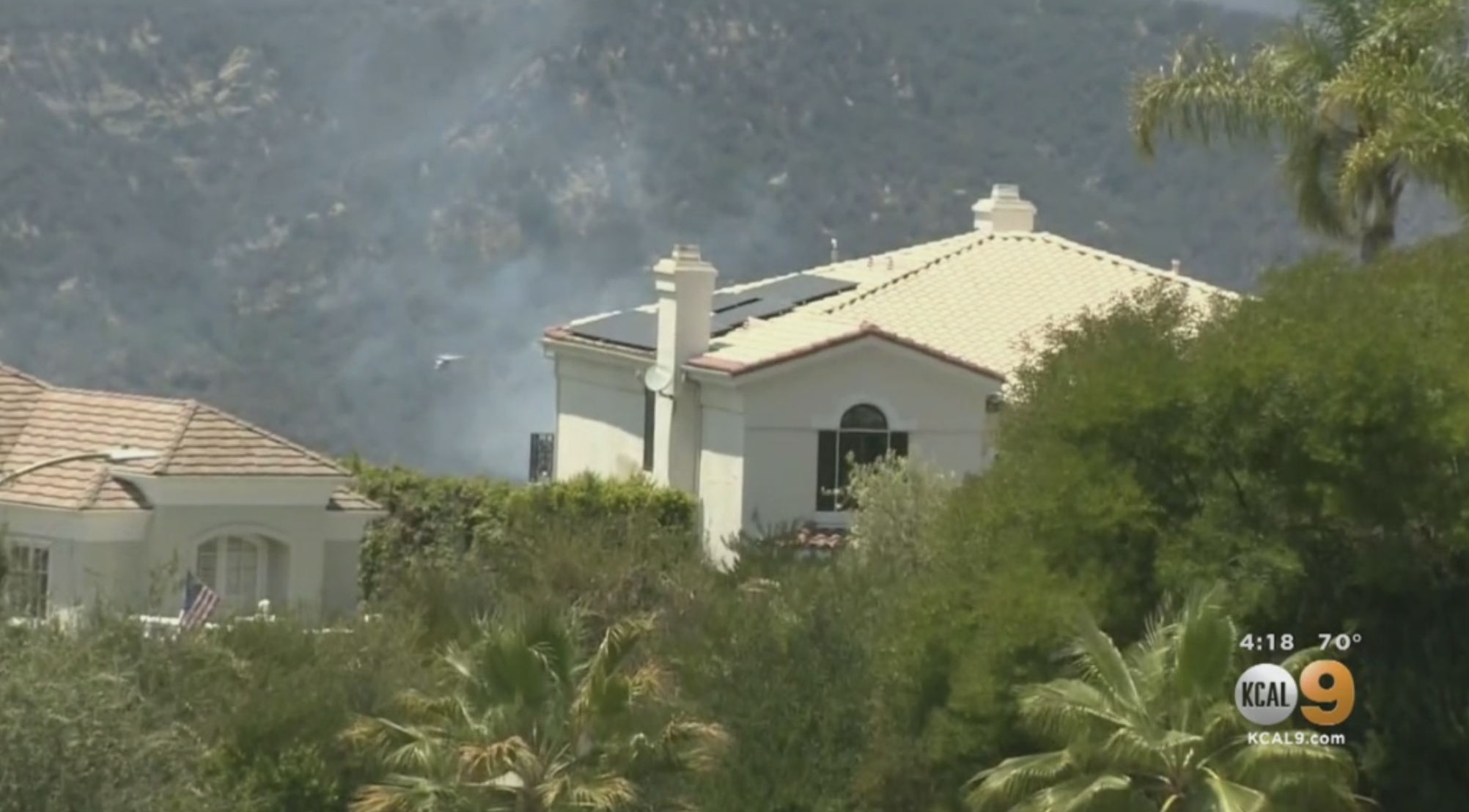
ELYSIAN PARK (CBSLA) – Amid devastating fires in Northern California, fire crews in SoCal are reminding homeowners to clear out brush as the area remains under extreme fire conditions.
“This stuff will burn through here really quickly and push up into the eucalyptus trees,” said David Ortiz, with the Los Angeles Fire Department, said of the dry brush near homes in Elysian Park, vegetation similar to what many of the hillsides in Southern California look like as a result of the ongoing drought.
Across the state, there are 15 wildfires burning, so LAFD is reminding homeowners, especially those that live in fire-prone areas, to cut back overgrown trees and do brush clearance around their homes.
(credit: CBS)
“People who live with this stuff behind their homes to be prepared,” Ortiz said. “They have to make sure they maintain that defensive space. If they do their part in maintaining that defensive space, then that helps us do our part.”
Fire officials, according to Ortiz, are concerned about areas like Elysian Park that, historically, have burned over the years. He said the department and residents were surprised by the Pacific Palisades fire back in May because it started in an area that hadn’t burned in decades.
“The Palisades was a surprising fire because the factors that we normally expect for extreme fire behavior were not there, and so we are finding all these areas we’ve done a good job putting fires out, in decades in the past, are starting to burn now,” Ortiz said.
With no end to the drought in sight, Ortiz said that residents should not let their guards down.
Luis Rodriguez, a homeowner in Elysian Park, said that being prepared comes with the territory of living close to a hillside.
“I have a tendency to always cut around 100-150 feet perimeter within my house. My backyard is the park area, so I have to be very vigilant about that,” he said.
As a preventive measure, the Forest Service said it’s closing all the national forests starting Aug. 31 through Sept. 17 to decrease the chances of wildfires breaking out.
"danger" - Google News
September 01, 2021 at 08:40AM
https://ift.tt/38vCPY0
Local Fire Officials Urge Residents To Clear Brush Amid High Wildfire Danger - CBS Los Angeles
"danger" - Google News
https://ift.tt/3bVUlF0
https://ift.tt/3f9EULr
The problem is not unique to the Biden administration, said the head of a nonpartisan group that tracks vacancies.
One of the running criticisms of the Trump administration was how slowly it nominated and won confirmation for hundreds of high-level government officials, especially in critical agencies like the State Department and the Department of Homeland Security.
But things aren’t going much better with the Biden administration. And arguably, the situation is worse: In the middle of a pandemic, there is still no confirmed head of the Food and Drug Administration, and there is no confirmed ambassador to Afghanistan to help manage the crisis there.
To understand what’s going on, I turned to Max Stier, the head of the Partnership for Public Service, a nonpartisan organization that tracks vacancies and advises the government on how to improve the nomination and confirmation process.
He made clear that while the Biden team was woefully behind, the problem was not unique to it — or to the Trump administration. Rather, he said, it’s typical of a broken system that has led to a long string of government failures.
“You can go back in time, if it was the response to Hurricane Katrina under the Bush administration, or the botched rollout of healthcare.gov under the Obama administration, or any number of issues in the Trump administration,” he said. “There is an execution gap of consequence. And one of the big reasons for that is that the leadership system is broken.”
A transcript of our interview, edited and condensed, follows.
Where does the Biden administration stand in terms of its nominations and confirmations?
There’s a set of 800 positions that we consider the most fundamental, and of those, they only have 127 that are confirmed, and they have 206 that are waiting in the queue. That still leaves a pretty substantial number that needs to be nominated.
It’s hard to believe, but we’re past the seven-month mark in this administration. You have a Senate that operates like a two-lane country highway, and you have a big traffic jam because you’ve got legislative priorities and budget issues and judicial nominations.
And why is this a problem? Don’t they have acting officials in place?
When no one’s there, you do have someone in the acting role, but they’re the substitute teachers. They might be amazing educators, but we all know that the substitute teacher doesn’t get respect from the class, and they don’t see their job as taking on the long-term problems because they don’t know if they’ll be around tomorrow. What I’m painting for you is a broader system failure in our government. You wind up with workarounds like acting leadership, or in the last administration, an effort to simply avoid a confirmed leadership in many instances.
Speaking of the last administration, how does President Biden’s record compare with Donald Trump’s?
The Biden team is ahead in their nominations of where Trump was at this point in time, but they’re actually neck and neck in the number of confirmed people.
It’s easy to see why the Senate could be a roadblock for confirmations, but what explains the lag in nominations?
There’s an interrelationship between the two. One of the challenges any administration faces is thinking about the likelihood of getting people confirmed. A difficult confirmation process impacts the nomination process. There’s a lot of risk aversion. And, frankly, their ability to recruit is hurt. Think about all the people who would throw in their hat knowing they’ll be a part of that cool-your-jet package. Everything you do gets scrutinized enormously, and you have to be thoughtful and careful about what you should be doing that might get you in trouble.
And to add a complication, a current nominee can’t also serve as the acting leader, according to a relatively recent Supreme Court decision. For example, if the Biden administration nominated Janet Woodcock to serve as the F.D.A. commissioner, she would have to step down from her present role as acting commissioner. Congress should fix this.
Which agencies worry you the most?
I think the State Department is plainly one of the most obvious places with significant gaps. Of the positions we track, the State Department has the most gaps of any agency. But the truth is, you only have 127 confirmed positions, so there are problems pretty much everywhere. The most noticeable ones are the places where there are current, obvious needs. So, there’s the international issues, whether it’s Afghanistan or China. You think about health care, where the lack of a confirmed F.D.A. commissioner is clearly a problem.
The Office of Management and Budget director is not as obvious, but I think it is a truly fundamental role. There is very little in the federal government that is focused on the enterprise as a whole, but the Office of Management and Budget is. It’s a tiny agency when you think about the entire government, but it’s the nerve center, and to not have a confirmed director is a problem.
Let’s take Afghanistan as a case study. How does the lack of confirmed positions hurt us there?
It’s impossible to show a causal relationship, but we don’t have an ambassador to Afghanistan, and while ambassadors aren’t everything, they are your key point of contact in any given country. And yes, there are plenty of people involved in Afghanistan, but you’d want every resource you could possibly have, and that’s one of them. I’m looking at the list of unconfirmed positions that might be needed over there: under secretary for public diplomacy, there’s no nominee. Assistant secretary for conflict and stabilization operations. There’s someone nominated and been reported out, but they’re waiting. Not good. The list goes on. There will be someone there, but they’re in acting capacities. That’s just not a recipe for the best we need for our agencies.
It’s not good for dealing with our allies, either.
Absolutely. And you do hear that fairly consistently. Our allies don’t feel they have the people they need to talk to. All these problems are better solved through multilateral exercises, so coordinating those relations with all those countries and international entities is fundamental to putting our best foot forward.
I keep coming back to this: The design of our system is broken. And we still have to work within the system until we fix it, and we’re not doing that well, either. But we could. For example, historically, right before the August recess, the past several presidents have gotten substantial packets of nominees through the confirmation process, on average about 60. The Biden team got 11. And that’s not good enough.
So what do you see as the solutions?
The easiest answer to having too many positions is to reduce them, substantially. This happened before, in 2011, when there was a reduction of about 160 positions. We need to see many multiples of that. You could cut in half the number of Senate-confirmed positions and not diminish the Senate’s important oversight responsibility. The Senate doesn’t lose if it has 600 rather than 1,200 confirmed positions, because it’s not actually getting the confirmation opportunity for those 1,200 positions.
Instead, some of them could be career positions. Some could be nonconfirmed political positions; some of them could be term positions. Depending on the nature of the job, you’d want to see different things. At the Department of Energy, Secretary Jennifer Granholm wants the cybersecurity position to be a career position, not a Senate-confirmed position, because she says there needs to be someone in that job longer than two years.
On the Senate side, you should improve the process. It doesn’t have to be so ugly. To go back to the two-lane highway proposition, it’s worse than that: It’s a two-lane highway that has a lot of potholes in it. They require people to submit their data multiple times, and there’s a huge amount of questions that get asked.
Out of that 2011 legislation, there was a commission created to talk about how to improve it, and there are a lot of recommendations that are out there. For example, right now, any Senate-confirmed position requires a full field investigation by the F.B.I. But doesn’t it depend on the nature of the job, whether you’re C.I.A. director versus the person in charge of public housing at Housing and Urban Development? They don’t distinguish, so the intensity of investment and intrusion is the same.
On Politics is also available as a newsletter.Sign up hereto get it delivered to your inbox.
Is there anything you think we’re missing? Anything you want to see more of? We’d love to hear from you. Email us atonpolitics@nytimes.com.
Video: Ivo Daalder, former U.S. ambassador to NATO and president of the Chicago Council on Global Affairs joins “Chicago Tonight” to talk about the U.S. military’s withdrawal from Afghanistan. (Produced by Paris Schutz)
WASHINGTON (AP) — As the final five U.S. military transport aircraft lifted off out of Afghanistan, they left behind up to 200 Americans and thousands of desperate Afghans who couldn't get out and now must rely on the Taliban to allow their departure.
Thanks to our sponsors:
Secretary of State Antony Blinken said the U.S. will continue to try to get Americans and Afghans out of the country, and will work with Afghanistan's neighbors to secure their departure either over land or by charter flight once the Kabul airport reopens.
"We have no illusion that any of this will be easy, or rapid," said Blinken, adding that the total number of Americans who are in Afghanistan and still want to leave may be closer to 100.
Speaking shortly after the Pentagon announced the completion of the U.S. military pullout Monday, Blinken said the U.S. Embassy in Kabul will remain shuttered and vacant for the foreseeable future. American diplomats, he said, will be based in Doha, Qatar.
"We will continue our relentless efforts to help Americans, foreign nationals and Afghans leave Afghanistan if they choose," Blinken said in an address from the State Department. "Our commitment to them holds no deadline."
Marine Gen. Frank McKenzie, head of U.S. Central Command, told reporters the U.S. military was able to get as many as 1,500 Afghans out in the final hours of the American evacuation mission. But now it will be up to the State Department working with the Taliban to get any more people out.
McKenzie said there were no citizens left stranded at the airport and none were on the final few military flights out. He said the U.S. military maintained the ability to get Americans out right up until just before the end, but "none of them made it to the airport."
"There's a lot of heartbreak associated with this departure," said McKenzie. "We did not get everybody out that we wanted to get out. But I think if we'd stayed another 10 days we wouldn't have gotten everybody out that we wanted to get out."
McKenzie and other officials painted a vivid picture of the final hours U.S. troops were on the ground, and the preparations they took to ensure that the Taliban and Islamic State group militants did not get functioning U.S. military weapons systems and other equipment.
The terror threat remains a major problem in Afghanistan, with at least 2,000 "hard core" members of the Islamic State group who remain in the country, including many released from prisons as the Taliban swept to control.
Underscoring the ongoing security threats, the weapon systems used just hours earlier to counter IS rockets launched toward the airport were kept operational until "the very last minute" as the final U.S. military aircraft flew out, officials said. One of the last things U.S. troops did was to make the so-called C-RAMS (Counter Rocket, Artillery and Mortar System) inoperable.
McKenzie said they "demilitarized" the system so it can never be used again. Officials said troops did not blow up equipment in order to ensure they left the airport workable for future flights, once those begin again. In addition, McKenzie said the U.S. also disabled 27 Humvees and 73 aircraft so they can never be used again.
Throughout the day, as the final C-17 transport planes prepared to take off, McKenzie said the U.S. kept "overwhelming U.S. airpower overhead" to deal with potential IS threats.
Back at the Pentagon, Defense Secretary Lloyd Austin and Gen. Mark Milley, chairman of the Joint Chiefs of Staff, watched the final 90 minutes of the military departure in real time from an operations center in the basement.
According to a U.S. official, they sat in hushed silence as they watched troops make last-minute runway checks, make the key defense systems inoperable and climb aboard the C-17s. The official said you could hear a pin drop as the last aircraft lifted off, and leaders around the room breathed sighs of relief. Later, Austin phoned Maj. Gen. Christopher Donahue, commander of the 82nd Airborne Division, who was coordinating the evacuation. Donahue and acting U.S. ambassador to Afghanistan Ross Wilson were the last to board the final plane that left Kabul.
Officials spoke on condition of anonymity to provide details of military operations.
"Simply because we have left, that doesn't mean the opportunities for both Americans that are in Afghanistan that want to leave and Afghans who want to leave, they will not be denied that opportunity," said McKenzie.
The military left some equipment for the Taliban in order to run the airport, including two firetrucks, some front-end loaders and aircraft staircases.
Blinken said the U.S. will work with Turkey and Qatar to help them get the Kabul airport up and running again.
"This would enable a small number of daily charter flights, which is a key for anyone who wants to depart from Afghanistan moving forward," he said.
Moderna Inc.’s Covid vaccine generated more than double the antibodies of a similar shot made by Pfizer Inc. and BioNTech SE in research that compared immune responses evoked by the two inoculations.
The study is one of the first to compare levels of antibodies produced by the two vaccines, which are thought to be one of the important components of the immune response. It didn’t examine whether the antibody differences led to a difference in efficacy over time between the two shots, which both were more than 90% effective in final-stage clinical trials.
The research looked at antibody levels against the coronavirus spike protein in about 1,600 workers at a major Belgium hospital system whose blood samples were analyzed 6 to 10 weeks after vaccination. The participants hadn’t been infected with the coronavirus before getting vaccinated. Levels among those who got two doses of the Moderna vaccine averaged 2,881 units per milliliter, compared with 1,108 units per milliliter among those who received two Pfizer doses.
The results, published Monday in a letter to the Journal of the American Medical Association, suggested the differences might be explained by the higher amount of active ingredient in the Moderna vaccine — 100 micrograms, versus 30 micrograms in Pfizer-BioNTech — or the slightly longer interval between doses of the Moderna vaccine — four weeks, versus three weeks for Pfizer-BioNTech.
Outside researchers said it was premature to conclude that the difference in antibody levels was medically important.
“I would urge caution in making the conclusion that because Moderna demonstrated a slightly higher peak on average that its efficacy will be slower to wane,” said David Benkeser, a biostatistician at Emory University, in an email. “Such a conclusion requires a host of assumptions that have not yet been evaluated.”
Both vaccines produce high levels of antibodies, he noted, and other studies have shown even relatively low levels of antibodies are protective.
Still, it’s possible that higher initial antibody levels might correlate with longer duration of protection against mild breakthrough infections, said Deborah Steensels, a microbiologist at Ziekenhuis Oost-Limburg, a large hospital in Belgium, who was lead author on the study. Also, if higher antibody levels are confirmed to be important, then the Moderna vaccine might be better for immunocompromised people who don’t respond well to vaccines, she said.
Pfizer said in a statement that its vaccine “continues to be highly efficacious” in preventing Covid-19, including against severe cases and hospitalization. A continuing analysis of its final-stage study has shown a decline of efficacy against symptomatic infection over time, the drugmaker said, but initial trial data also show that a third dose of the existing vaccine at least six months after the first two significantly raises neutralizing antibody levels.
Moderna’s vaccine was associated with a two-fold risk reduction against breakthrough SARS-CoV-2 infections compared to Pfizer’s in a review of people in the Mayo Clinic Health System in the U.S. from January to July. The results were reported in a separate study released ahead of publication and peer review on Aug. 9.
More stories like this are available on bloomberg.com
"many" - Google News
September 01, 2021 at 01:36AM
https://ift.tt/3DCZQqc
Moderna vaccine makes twice as many antibodies as Pfizer, study says - The Mercury News
"many" - Google News
https://ift.tt/2OYUfnl
https://ift.tt/3f9EULr
ECHO LAKE, Calif. – Aug. 30: Jason Higgins monitors the march of the Caldor Fire as it burns down the face of Echo Summit into the Christmas Valley section of Meyers, Calif. Monday, Aug. 30, 2021. (Karl Mondon/Bay Area News Group)
The Caldor Fire threatening communities and breathtakingly scenic landscapes around Lake Tahoe — a destination that Mark Twain once called “the fairest picture the whole earth affords” — is a dramatic, unfolding disaster.
But the conditions that led to the evacuation of more than 50,000 people around the famed alpine lake’s south and western shores — where embers rain down on rustic communities and soot chokes the normally pristine mountain air — didn’t spring up this week, this month or this year. They are the culmination of more than 150 years of decisions that people made to unwittingly set the stage for today’s catastrophe, experts say.
“We are in an emergency crisis throughout the Sierra,” said Susie Kocher, a forestry and natural resources adviser for the University of California Cooperative Extension in South Lake Tahoe.
Kocher, her husband, dog and cat evacuated their home in nearby Meyers on Monday to stay with relatives near Sacramento. Before she moved to the Tahoe area 15 years ago, she lived in Greenville, a small town in Plumas County. Nearly all of Greenville burned to the ground last month when the Dixie Fire raged through the northern Sierra Nevada’s forests.
“I’ve been watching the Dixie Fire and thinking about how this town could burn down too,” said Kocher, a registered professional forester. “It’s pretty obvious these fires are beyond our control. If you are anywhere in the direction the wind is blowing, you should be packing up.”
The problem around Tahoe, as with much of the Sierra range, Kocher and other fire experts said, dates back to the 1850s.
For centuries, fires burned about every 10 to 15 years on average through the forests around Lake Tahoe, said Brandon Collins, a research scientist with the U.S. Forest Service and adjunct professor of fire science at UC Berkeley.
Those fires, set by lightning strikes or by the native Washoe people, removed dead wood, accumulated needles and other fire hazards. When fires did burn, they typically remained close to the ground, and burned slowly. But everything began to change in 1859, when a huge deposit of silver was discovered 15 miles east of Lake Tahoe in Virginia City, Nevada.
Miners working on the Comstock Lode, which became the richest silver mine in the United States, clear cut large sections of Tahoe’s forests to obtain supports for the huge networks of underground tunnels. They removed large Jeffrey pines and other trees that were spaced apart by years of fires.
“There were big trees, lots of open spaces,” Collins said. “Now it’s kind of wall-to-wall trees.”
What grew back were dense numbers of white fir and other trees. Not only did the firs have thinner bark that made them more vulnerable to fire than the older pines, they have lower branches which makes it easier for fire spread.
John Muir, the conservation pioneer who founded the Sierra Club and helped save Yosemite Valley, wrote a letter in 1878 to the San Francisco Bulletin, sounding the alarm.
“In summer, the woods resound with the outlandish noise of loggers and choppers and screaming mills,” Muir wrote.
Muir tried to convince Congress to establish Lake Tahoe as a national park as he did with Yosemite. But in large part because of Tahoe’s damaged landscape and because of opposition from local landowners, lawmakers refused. Senators introduced bills in 1912, 1913, and 1918 without success.
Private development sprung up in the 1920s, including casinos, resorts and vacation homes. It expanded after World War II, bringing Frank Sinatra, Marilyn Monroe, the mob, speedboats, glitz and glamor. Neighborhoods of wooden homes with shake roofs were built in narrow streets under forests that once regularly burned. To protect those developments, fire crews began putting out fires.
With no fire to thin them, the forests grew thicker. In some places, where there were 20 to 40 trees per acre in 1850, there are 10 times as many today, Collins said.
Large sections of Tahoe’s forests have gone 100 years without a fire. So when fires do start, they burn much hotter and more violently. And Tahoe officials, because of the region’s popularity, have done more work to reduce fire risk than many other parts of the Sierra Nevada, he noted.
In 1997, as part of the growing effort to preserve the lake’s clear waters from pollution, former President Bill Clinton and Al Gore held a summit at Lake Tahoe. New federal, state and local conservation plans were drawn. Since then 65,000 acres have been thinned or treated with prescribed burns around the 200,000-acre Tahoe basin, most of which is owned by the U.S. Forest Service, according to the Tahoe Fire and Fuels Team, a partnership of government agencies.
That work has gone well, Kocher said. But it must be expanded dramatically, particularly as climate change continues to dry out forests with higher temperatures.
“We need to think about making peace with fire, not just making war on it,” she said. “We’re good at that, but we aren’t winning.”
Collins agreed. He said forest-thinning efforts across the Sierra should be increased five-to-tenfold in the coming years. Such projects can be challenging, he noted, with controversies over smoke from prescribed burns, a cost of about $2,000 an acre with millions of acres needing treatment, and a shortage of places to take the wood, leaving it often chipped onsite.
“A lot of the early work, for good reason, was done right around homes and roads,” Collins said. “But we need the work to be done on a much bigger scale.”
Kocher, who has helped her neighbors prepare for fire, noted that in some cases, fires burn so hot, like the Angora Fire near Meyers did in 2007, that Jeffrey pines and other native trees must be replanted to keep the area from being overrun later with shrubs. Working with fire before it explodes out of control is the only way to unwind 170 years of history and restore forests to a more natural condition, she said.
“The money flows when there is a disaster,” Kocher said. “But there’s often not enough for prevention.”
Lake Tahoe’s Emerald Bay is normally a world famous tourist destination. But the Caldor Fire, which prompted mass evacuations on Aug. 30, 2021 from south and west Lake Tahoe, has blanketed the area with smoke and burned forests and homes only a few miles away. (Getty Images)
Flooding and tornadoes were not the only problems created by Tropical Storm Ida in Alabama.
Washed out rural roads, and worries about bridge safety, is also part of the storm’s aftermath.
A collapsed county highway in Mississippi – about 30 miles from the Alabama state line – led to tragedy early Tuesday, and has generated national media attention all day. But worries also exist in Baldwin and Mobile counties, where highway engineers are monitoring the safety of roads and bridges pelted with two days of persistent rains as Ida’s feeder bands whipped coastal Alabama.
In one area of Baldwin County, at least 25 residents are stranded and unable to access a public roadway from their properties.
River Road
The Baldwin County Highway Department is assessing damage to River Road north of Interstate 10 in the Elsanor community. A creek that flows into the nearby Styx River overtopped the road and washed it away.
County Engineer Joey Nunnally said repairs to the road “are at the top of our list” for repairs “as soon as the water recedes.”
That is expected to occur soon, according to Jenni Guerry, deputy director with the Baldwin County Emergency Management Agency. The Styx River crested Tuesday afternoon at 15.24 feet, which placed it in “moderate flood stage,” Guerry said. She said it will soon decrease. The river, at 12 feet, is considered in a “minor” flood stage.
Guerry said that her EMA staff, during a tour of the area on Monday, learned about the residents who are unable to leave their homes until the water recedes.
“When we spoke with them, there was no one in crisis or danger,” Guerry said, who added that residents are in contact with a local volunteer fire department and the county’s 911 system “to make sure they can make accommodations if there is an emergency response.”
The washout occurred where River Road encounters Flat Creek, which flows directly into the Styx River. The same creek also caused flooding on Truck Trail 17, which is north of River Road.
Nunnally said that River Road has washed out before. He said it will only take “about a day or two” to repair the road, at a cost of around $50,000 to $75,000.
“We have tried to get some grant money in the past to relocate the road out of the floodplain, but was unsuccessful,” he said. “Historically, the residents have used some private roads to access Truck Trail 17 to travel to and from their residents when Styx River floods.”
The county is also monitoring river stages at Fish and Perdido rivers. Only Perdido reached “minor” flood stage during the tropical storm, but it has since receded.
“We have been and will continue to inspect roads (Tuesday) for safety issues and any compromised areas but we don’t know of any at that moment,” Nunnally said earlier on Tuesday. “The upgrades that we have done to our infrastructure after past storms have mitigated any damages that we may have had.”
Mobile County
In Mobile County, Roberts Road between Kidd Road and Old Citronelle Road in Chunchula remained closed because flood waters rose above the bridge. Barricades and signage were installed to warn people of driving over it.
“Road and bridge safety is always a priority,” said Mobile County Engineer Bryan Kegley. “Mobile County Public Works forces will be spending considerable effort to check roads and bridges this week, including full inspections as necessary to ensure safe travel.”
He said the county will pay close attention to the Escatawpa River watershed in the coming days “because it typically rises later than smaller watersheds.”
Mike Evans, deputy director with the Mobile County EMA, said he’s not heard in recent years “chatter, complaint or questions” about dangerous public roads. He said the complaints to his office are often from people who are worried about private roads, which the county is not responsible to maintain.
Evans said that from a county EMA perspective, the message during rain events that can cause flooding, is this: If there is water on the road, do not drive through it.
“You might look at it and say, ‘That’s just 1 foot of water on the road,’ and it might only be that much,” Evans said. “But more of it might be washed out. If you can go another way, you stop, turn around and go another way.”
The concerns about the roads comes after a tragic collapse of a two-lane highway near Lucedale, Mississippi, early Tuesday morning. Two people were killed and at least 10 others were injured when seven vehicles plunged into a deep hole along Mississippi Highway 26, west of Lucedale.
The NWS in Mobile reported 4 to 8 inches of rain accumulated in Mobile and Baldwin counties during the two-day tropical storm. The heaviest rains accumulated in west Mobile at Mobile Regional Airport, which recorded 7.25 inches of rain.
In this image made from video and provided by WLOX-TV, a vehicle is extracted from a hole on highway 26, Tuesday, Aug. 31, 2021, near Lucedale, Miss. Troopers have said that both the east and westbound lanes of Highway 26 in George County west of Lucedale collapsed. (WLOX-TV via AP)AP