The Lakers will have to play an extended stretch without their best player — again.
Los Angeles announced on Nov. 30 that LeBron James has entered the NBA's health and safety protocols. The four-time MVP, who missed 11 of the Lakers' first 22 games because of multiple injuries and a suspension, is now expected to sit out several more games, according to ESPN's Adrian Wojnarowski.
What's next for James? Here's everything we know about his status and the latest news on when he may return to the court.
Why did LeBron James enter the NBA's health and safety protocols?
James entered the league's health and safety protocols before the Lakers' Nov. 30 game against the Kings because he tested positive for COVID-19, according to a TMZ Sports report. After Los Angeles' 117-92 win over Sacramento, Lakers star Anthony Davis told reporters that he had spoken to James about his condition.
"[James] said he's good," Davis said. "I think he's asymptomatic, which is a good sign, but we want to make sure that he gets back. Health is most important. This is bigger than basketball. He has a family. We want to make sure that he's good no matter what. ... Like I said, he seemed to be fine."
Before the start of the 2021-22 season, James publicly declared that he had been vaccinated against COVID-19. However, he didn't go so far as to position himself as a vaccine advocate.
"We're talking about individuals' bodies," James said at the Lakers' media day. "We're not talking about something that's political or racism or police brutality and things of that nature. We're talking about peoples' bodies and well-beings. I don't feel like, for me personally, that I should get involved in what other people should do for their bodies and their livelihoods. It would be me, talking about somebody, if they should take this job or not. Listen, you have to do what's best for you and your family, if they should relocate. You have to do what's best for your family.
"I know what I did for me and my family. I know some of my friends and what they did for their families. But as far as speaking for everybody and their individualities and things that they want to do, I don't feel like that's — that's not my job."
Lakers coach Frank Vogel said on Nov. 30 that he hopes James' absence is only something that will be "short-term," but it's unclear how long he will be sidelined.
The NBA mandates that a player who tests positive for COVID-19 must be away from his team for a minimum of 10 days or until he returns two negative PCR tests within a 24-hour period. If James is out for the full 10 days, he would miss a total of five games.
"It wasn't, like, a shocker for us. We just said we couldn't catch a break," Davis said. "We were just getting guys back, and then he's out for however many days. We don't know. It all depends on his situation. But you've still gotta find ways to win."
"many" - Google News
December 01, 2021 at 11:34PM
https://ift.tt/3xH6dGH
LeBron James enters NBA's COVID-19 protocols; How many games will Lakers star miss? - Sporting News
"many" - Google News
https://ift.tt/2OYUfnl
https://ift.tt/3f9EULr
“… the people refused to obey the voice of Samuel; and they said ‘No, but we will have a king over us, that we also may be like all the nations, and that our king may judge us and go out before us and fight our battles.'” — 1 Samuel 8:19-20
Enter Omicron. Nature’s vaccine. But free; much too free, and it doesn’t require any special administration, nor does it require any special oversight, any new agency or organization, any emergency powers, any massive spending and taxing and all the control, the ceding authority to expert opinion that must necessarily accompany such important endeavors to save humanity; it doesn’t require any force at all, and really … there is nothing more dangerous and terrifying than that.
But it doesn’t really matter whether Omicron is nature’s vaccine or not. It wouldn’t really matter of Omicron was just the same as alpha, or beta, or delta … or kappa, epsilon, zeta, eta, theta, iota, or any of the other possible and inevitable variants that have come and which are sure to follow. Those are all distractions, just the same as “do they work?” is an irrelevant distraction when discussing whether governments should be permitted to force individuals to cover their faces with masks.
These are all questions for free societies. “Does it work?” is a relevant consideration when taken as a part of the complex analysis that is individual decision-making; when I decide whether I want to engage in some particular action. As we know, free societies permit and foster the creation of knowledge. Even something so simple as “is this a good product?” can only be determined by consumer action, not bureaucratic preference. Or, “is this a desired product?” Imagine the fashion czar, having determined that gray collarless quarter-button shirts ought to be produced and sold en masse, confronted with alternate preferences: So it’s easy to criticize, but they’re really criticizing fashion because I represent fashion. That’s dangerous. To me, that’s more dangerous than the slings and the arrows that get thrown at me. I’m not going to be around here forever, but fashion is going to be here forever. And if you damage fashion, you are doing something very detrimental to society long after I leave. And that’s what I worry about.
No, of course, fashion is different. It isn’t set in stone, it isn’t something that can be determined with test tubes and Petri dishes, it is mere preference. Stop being ridiculous. Stop messing with Science.
Right. Science is going to be around forever. Well … unless it isn’t. Unless you know what science actually is. Like economics, real science only exists in free societies. A person might quibble over the details. Merriam-Webster seems like a good source, no? I have a copy of the New World Dictionary on my shelf, dated 1966, so perhaps that is before words like supposably made their appearance… but Mr. Webster wasn’t going to be around forever, after all. Regardless, my dictionary defines science as, originally, simply “knowledge.” But, second, “systematized knowledge derived from observation, study, and experimentation.” And “systematized” means methodological, so, not random knowledge, then? But knowledge derived from observation, study, and experimentation, which has been … organized?
Mr. Fauci may represent, in a certain twisted sense of the word, “systematization,” but he certainly doesn’t represent observation, study, or experimentation. In fact, it is those very things that he is rejecting and censoring when he claims to represent science. Odd. It seems that the systematization may sometimes work to undermine certain observations, studies, and experiments.
Webster also has a website, which defines science as “the state of knowing: knowledge as distinguished from misunderstanding or ignorance.” I guess that’s the 2021 version; unlike science, it may be that language isn’t around forever, unchanging, outliving Messrs. Merriam and Webster. Or maybe it is simply trying to weather all of those slings and arrows; to protect against misinformation. Science is knowledge, knowledge is understanding and knowing … derived perhaps from science? From observation, study, and experimentation? So then, what is misinformation? Is misinformation something that runs contrary to science? Perhaps it is something that runs contrary to the scientist – the authority, who represents science.
It seems to me that misinformation, if defined as something that is incorrect, having perhaps come from a faulty observation, study, or experiment, is still science. In fact, I might even suggest that it is essential to the ongoing pursuit of meaningful science. But then, I’m only thinking back to the 7th grade, when I learned about the scientific method; when I was told that science was not knowledge, but the pursuit of knowledge, and that the two are very importantly different. I am thinking of a science through which hypotheses are made and experiments are designed to falsify; where hypotheses sometimes become theories, but where theories very rarely become laws because it is only meaningful to say that “science will be around forever,” if what you are saying is that knowledge is in a constant state of flux, and that very little is ever finally set in stone. But if that is the sense in which we understand science, than perhaps the most unscientific statement ever uttered would be something along the lines of: So it’s easy to criticize, but they’re really criticizing science because I represent science. Yes, that absolutely is dangerous – not the criticism, but the idea that any one scientist might represent science, and that science itself – which, in its essence, is very little more than the constant exercise of criticism, through observation, study, and experimentation – cannot be criticized. That is very dangerous, indeed!
Of course, it is absolutely true that science will be around forever. It is also true that truth will be around forever; whether and to what extent we are capable of understanding and organizing that truth at any given time is unknown, but truth certainly doesn’t change along with our ever-changing whims about its convenience, its political-correctness, whether we like it, and whether or not we even seek it.
Fauci’s view is not a new one. A hypothesis that has failed the tests of observation, study, and experimentation would be demoted under the scientific method as I learned it. When criticism of the hypothesis is criticism of the scientist, and criticism of the scientist is an attack on science, however; enter Omicron, enter a fifth wave.
…But new waves rolled from the collectivized villages: one of them was a wave of agricultural wreckers. Everywhere they began to discover wrecker agronomists who up until that year had worked honestly all their lives but who now purposely sowed weeds in Russian fields (on instructions, of course, of the Moscow institute, which had now been totally exposed; indeed, there were those same 200,000 unarrested members of th3 Working Peasants Party, the TKP!). Certain agronomists failed to put into effect the profound instructions of Lysenko – and in one such wave, in 1931, Lorkh, the so-called “king” of the potato, was sent to Kazakhstan. Others carried out the Lysenko directives too precisely and thus exposed their absurdity. (In 1934 Pskov agronomists sowed flax on the snow – exactly as Lysenko had ordered. The seeds swelled up, grew moldy, and died. The big fields lay empty for a year. Lysenko could not say that the snow was a kulak or that he himself was an ass. He accused the agronomists of being kulaks and of distorting his technology. And the agronomists went off to Siberia.) Beyond all this, in almost every Machine and Tractor Station wrecking in the repairing of tractors was discovered – and that is how the failures of the first collective farm years were explained!
— Alexander Solzhenitsyn, The Guluag Archipelago, vol.1, pg. 57
Omicron will be unique in the same way that Delta was. It will evade all our well-established science, just as Delta before it, just as Alpha prior, unless we take action! There are still so many unmasked, yet to be covered. There are still so many unvaccinated, yet to be jabbed. There are still so many voices spreading misinformation, yet to be silenced!
Lysenko couldn’t be revealed as an ass, because the party is never wrong – to criticize the party is to criticize science, because the party represents science. And if observation, study, and experimentation showed something different, something often undeniably and starkly different, well… those attacks on science must be stopped; perhaps merely shown to be misinformation. History would even be re-discovered if necessary. And what of January 6, senator?
Joe Biden read a speech that may well have been written by Anthony Fauci, but perhaps it was believed that the President could draw a larger audience than the good Dr.’s thousandth appearance on MSNBC:
A year ago, America was floundering against the first variant of COVID. We beat that variant significantly, and then we got hit by a far more powerful threat: the Delta variant. But we took action, and now we’re seeing deaths from Delta come down. We’ll fight the –- you know, and –- look, we’re going to fight and beat this new variant as well.
See how easy it is?
This is why “does it work?” is a distraction. What if Lysenko happened to have some successes to claim? What if instead of creating famine after famine, the tyranny of Stalin had also managed to feed its people? What if – sometimes – it worked? (Or if, as seems more likely, the president could still give speeches claiming victory for things that he had only done everything in his power to destroy.) We have some hypotheses that have been tested through observation, study, and experimentation – and some of those experiments are still running, in China, in Venezuela. Some of what we’re observing is violence and uprising in Europe in response to increasing totalitarianism, though it is difficult to observe what governments do not permit to be shown. One who is scientifically minded could do worse than to modify his hypothesis, slightly, and ask whether we are studying the right things, taking the right lessons from what we observe, noting the outcomes of hundreds of years’ worth of experiments – he might ask: “so what if it did work? Is it worth what we lose in return?” Lysenko was always able to find wreckers. He was always able to explain why it really does work. He was always able to win the argument, because the only demand he even pretended to address was “justify your actions,” and only on his terms; to criticize the scientist was to attack science itself. Those who engaged in that sort of observation, study, and experimentation were spreaders of misinformation, deliberate wreckers, enemies of the party, of the people, of science. Those were all people with the wrong hypotheses; they asked “but does it work?” when the only real question was ever “by what right do you rule over us?” and the people who asked that question did not even make it to Siberia.
We do now face a serious and life-threatening danger; it’s one we have seen before, and it isn’t Omicron.
In several countries, the State Department has blocked foreign entrepreneurs from entering the United States on E visas, which are one of the few ways foreign nationals can start a business in America. Unlike Canada, Australia and the United Kingdom, no startup visa exists under U.S. law that allows temporary status and permanent residence after creating jobs in a new U.S.-based business. The problems for E visa holders come as foreign direct investment in the United States has plummeted in recent years.
What is an E visa? “The E category includes treaty traders, treaty investors, and certain nonimmigrant employees of such people (and their spouses and children) who come to the U.S. under a treaty of commerce and navigation between the U.S. and their country of nationality,” according to U.S. Citizenship and Immigration Services. “Treaty traders (E-1 visas) pursue substantial trade in goods, including (but not limited to) services and technology, principally between the U.S. and their country of nationality. Treaty investors (E-2) direct the operations of an enterprise in which they have invested, or are actively investing, a substantial amount of money.”
Over the past two years, the entry of E visa holders has dropped precipitously, despite U.S. treaty obligations. “The problem is that a number of U.S. consulates have refused to adjudicate applications by investors and entrepreneurs for E-2 treaty investor visas from the commencement of the pandemic until the present day,” said H. Ronald Klasko of Klasko Immigration Law Partners in an interview. “This is in violation of bilateral investment treaties between the U.S. and host countries around the world. This is highly surprising and unprecedented given that the visas are given to foreign nationals who invest a substantial amount in a U.S. business that will create jobs for U.S. workers.”
The action or inaction has created problems for foreign entrepreneurs. “With consuls not adjudicating the applications, these businesses cannot open and operate, and jobs cannot be created,” said Klasko. “The solution is not complicated: the Visa Office in Washington, D.C. needs to advise U.S. consulates that they do not have the discretion or option to refuse to accept or adjudicate E-2 visa applications.”
The treatment of E visa holders and EB-5 (employment-based fifth preference) investors has happened at the same time foreign direct investment in America, which is essential to creating jobs and growth, has plunged. “Expenditures by foreign direct investors to acquire, establish or expand U.S. businesses totaled $120.7 billion in 2020, down 45.4% from $221.2 billion in 2019,” according to the Bureau of Economic Analysis of the U.S. Department of Commerce.
Between 2018 and 2020, foreign direct investment fell by 61%, from $312 billion to $120.7 billion. On immigration, the problem is not only with E visas and the State Department, say attorneys. “The antagonism toward foreign investors in the U.S. is also exhibited by USCIS. EB-5 petitions are given the lowest priority and have the longest processing times,” according to Klasko. “The quoted processing times for EB-5 petitions is 44 to 77 months. That makes absolutely no sense if the country is trying to encourage foreign direct investment. The processing time for I-829 condition removal petitions for EB-5 green card holders is 38 to 63 months. The regulations state that these petitions must be adjudicated within 90 days.”
At many U.S. consulates, issuing E visas halted or fell dramatically in 2020 and 2021. “A number of consulates stopped all or nearly all adjudications of E visas now for over 20 months, including Ankara, Bogota and Bridgetown,” said Tammy Fox-Isicoff of Rifkin & Fox-Isicoff in an interview. “There are about 10 more on this list. Nationals of these countries cannot renew E visas or get new E visas to manage their investments. Many are scared their businesses will fail. Others have accepted E visa applications but generally have not given E appointments for interviews, such as in Panama and Paris.”
Copies of U.S. consular email responses I received from immigration attorneys confirm Fox-Isicoff’s assessment. An E visa applicant from Bogota was sent an email that said: “In response to your communication, we will inform you that unfortunately, until this moment we can’t handle this kind of visas.” From the U.S. consulate in Istanbul: “Due to the Covid-19 global pandemic only limited nonimmigrant visa services are being offered. Currently, we are not accepting E visa applications.”
In Bogota, the State Department issued no E visas in September 2021. At some locations, such as Paris, Buenos Aires, Copenhagen, Istanbul, Madrid and Luxembourg, E visas were issued but down approximately two-thirds or more when comparing the third quarter (July to September) of FY 2021 to the third quarter of FY 2019, according to a National Foundation for American Policy analysis. For other locations, including Frankfurt, Taipei, Bangkok, Ciudad Juarez and Tokyo, the data show the number of E visas issued was similar in the third quarter of FY 2019 and FY 2021.
The State Department announced new guidance on November 19, 2021, aimed at loosening policies introduced during the Covid-19 pandemic. The guidance states, in part, “Embassies and consulates have broad discretion to determine how to prioritize visa appointments among the range of visa classes as safely as possible, subject to local conditions and restrictions.”
“The Department recognizes that visas for work and tourism are the foundation of President Biden’s foreign policy for the middle class and international visitors are essential to the U.S. economy and to the travel and service industries,” according to a State Department official on background. “We are aware that as routine visa processing is re-introduced at some embassies and consulates that have not been able to schedule appointments, applicants may face extended visa interview wait times. We are committed to lowering those wait times as quickly and safely as possible, recognizing that visas for work and tourism play a critical role in the U.S. economy. Regular updates on estimated nonimmigrant visa (NIV) wait times are available on travel.state.gov.”
The policy to date has frustrated entrepreneurs and their attorneys. “Imagine opening up a business pre-pandemic, investing $250,000, hiring four workers, and your consulate won't accept an E application, so you can’t come here to run the business?” asked Fox-Isicoff. “I would never have imagined that 20 months after my Colombian clients applied to renew their Es for the fourth or fifth time, their Es would still be pending. These foreign investors are really at wit’s end.”
A Fox-Isicoff client, Frank (he requested his last name not be used), owns an auto detailing business in Florida. He lived in the United States on an L visa but needed to leave to maintain lawful immigration status. Frank attempted to return on an E visa but to no avail. He and his family have been living in France during much of the pandemic and waiting for a visa.
“No one in Miami understands that I can't be there to oversee my investments,” said Frank in an interview. “This situation is costing me a lot of money. My next big strategic move is to find a bigger, better-exposed location for my car business. Even if the search happens online, it turns out that to commit to a one-year lease at a location, most people need to go to the location, check it out and drive around it. I lost one year on my business plan because of that. I have another business unit that I want to start—getting a dealer license for my business—and it turns out that also can’t be done when you’re out of the country. Finally, I have no access to credit, although I have an excellent credit score, as I don't have a valid visa for my passport.”
Frank said the situation has also taken a personal toll. “With my family, we've been forced to stay away from home for almost 10 months now, and nothing is making us think we’re going back any time soon,” he said. “Although we try to stay positive, every day is a struggle. We are lucky enough to have strong family and friends, so we could find places to stay overtime in France. Our kids don’t know a school system other than the U.S. one. Although our school was kind enough to accept our kids online last September, they advised us that as of January 2022, they won't be able to keep our kids online. It's a very stressful situation for parents and kids. We feel left out. It’s not like we did anything wrong.”
“This is clearly an abrogation of our treaty obligations,” said Fox-Isicoff. “We might as well hang a sign on our front door saying foreign nationals are not welcome and keep your investment dollars at home.”
A customer pays for a purchase at Herbal Outfitters in Valdez in 2016. (Marc Lester / ADN)
Five years ago, when Alaska’s first legal cannabis shops started opening, there was a lot of money to be made.
“We had three fabulous, great years,” said Sue Nowland, whose Alaska Fireweed was among the first cannabis stores to open its doors in Anchorage.
Those days are over.
Cannabis businesses across the state are confronting a daunting set of issues that owners and advocates say are making it nearly impossible to survive. Some Alaskans who poured their life savings or retirement accounts into starting companies are scrambling to find someone to buy them out. Operations are failing, others are in the red and behind on taxes owed to the state.
One measure of the industry’s problems is tax delinquency: according to an August memo from the Department of Revenue, by the end of June, 56 businesses owed $1,785,751 in back taxes. Nine of the delinquent businesses have closed, though collectively they still owe hundreds of thousands of dollars in unpaid taxes.
The most salient problems, according to people within the industry, are the flat excise tax structure placed on cultivators, an over-saturation of retailers and the rigidity to which licenses are tied to real estate.
Some say the industry’s current woes are normal growing pains to be expected as a new sector of the economy finds equilibrium. But others, including many business owners and the industry’s chief trade group, are debating potential reforms that could stave off looming business defaults as more license applications work their way through the pipeline.
The Alaska Fireweed cannabis retail store in 2018. (Annie Zak / ADN)
“They got dug in a hole”
In October, the Marijuana Control Board did something novel: for the first time, the panel effectively closed a cannabis business because of the taxes it owed.
The company, Alaskan Blooms, runs a cultivation facility and retail shop in Fairbanks. It owes the state around $700,000 in back taxes.
“This is a hard one,” said Jana Weltzin, the company’s attorney.
She was speaking to the board members during a meeting at the end of October. She described the accumulated tax debt as the fault of a former business partner who has since been removed from the license. Almost $200,000 of the amount owed was from interest and penalties on the overdue balance.
“They got dug in a hole,” Weltzin told board members.
Her attorney asked the board to give the business until January to pay back 50% of the taxes owed.
“If this tax burden wasn’t in the picture, we would be profitable,” said Karen Lowry, one of the Alaskan Blooms owners.
“Everything is going to this tax bill,” Weltzin added.
One member was skeptical that the business would be able to catch up with all the money owed.
Weltzin told the board the cultivation business employed around 20 people. Lowry, she said, had made efforts to stay current with the taxes. Cannabis businesses can’t use banks, and even if Alaskan Blooms could find an entity to loan them money it would likely come at an exorbitant interest rate. And, Weltzin argued, if the board denied the license renewal, there might be no mechanism for the state to recover the money owed.
But the board was unswayed.
“This is an egregious violation,” said member Christopher Jaime.
Board members voted unanimously not to renew Alaskan Blooms’s cultivation license, though did opt to let the business keep its retail license. It was the first time the board denied a license renewal to a business because of an outstanding tax liability.
Lowry declined a request for an interview.
Monkey Grass Farms employees clip buds from leaves and stems of marijuana plants in 2014, in East Wenatchee, Washington. (Marc Lester / ADN archive)
Alaska is unique in how it taxes cannabis relative to other states. Instead of charging at the point of sale, like a tax on groceries collected at the cash register, growers pay the state a flat rate of $800 per pound on cannabis buds. “Trim,” the plant leaves and byproduct manufactured into edible and concentrated products, is taxed at $240 a pound.
The problem with the flat-tax structure, growers say, is that unlike any other agricultural products, they are responsible for the same amount of money regardless of whether the crop turns out highly potent or ends up an impotent bust.
According to multiple owners, cannabis bud, or “flower,” remains the mostly popular product in retail shops, and accounts for the majority of the state’s tax revenues. To the consternation of growers and cannabis connoisseurs in Alaska, consumers have continued favoring high-THC flower strains, almost like beer-drinkers seeking out the most alcoholic IPA’s because they equate “stronger” with “better.” A brewer, on the other hand, might emphasize qualities like flavor, mouthfeel and complexity in quality determinations.
According to Lacy Wilcox, president of the Alaska Marijuana Industry Association, while high-THC crops could sell for around $4,000 a pound, the $3,000-range is more typical. But if a crop sample sent off for a potency test comes back from a lab with a THC level of, for example, 16% — “Which isn’t a high test,” Wilcox said — then the cultivator might only be able to get a $2,000 price for wholesale. After the state taxes are paid, that leaves the cultivator with $1,200 to cover the labor, rent, supplies, and energy costs that went into that crop.
“Which is not enough in Alaska,” Wilcox said.
The flat tax on weight, Wilcox said, means growers are constantly struggling to produce more potent flower because it is the only way for them to earn a profit on a crop.
But if buds turn out mild, cultivators face a choice of either selling them at a loss, or destroying them to avoid a tax liability.
“The amount of waste hurts my heart a little bit,” Wilcox said.
(Bill Roth / ADN)
The $1.8 million in unpaid taxes is a small share of the total money cultivators pay the state. In fiscal year 2021, the State of Alaska collected just under $29 million. Of that, $19 million was brought into state coffers from 11.8 tons of flower, an amount that works out to a little more than half an ounce per Alaskan. And that is not counting trim.
Wilcox called tax delinquency in the industry “probably topic number one,” in part because there is still a lingering stigma around cannabis.
“We don’t want to look bad as an industry,” Wilcox said. “Taxes are a part of that.”
“Nobody’s getting rich”
Even though there is a consensus in the industry that the current tax structure is a problem, there is no clear policy fix at hand.
“The current tax is not sustainable, so there’s agreement there,” Wilcox said.
A more vexing problem, though, is whether or not there should be a cap on licenses. Unlike some other states, Alaska has no limit on the number of cannabis licenses it will issue, provided applicants meet the qualifications. As more and more people have jumped into the industry, it has led to what many call an over-saturated market, especially among retail operations. In October, Politco reported that Alaska has more licensed cannabis stores per resident than any of the other western states that have legal sales.
Feedback to the MCB on the issue of license caps tends to be evenly split between those for and against.
“We need to do something to protect our industry in the state,” said Lisa Coates, an owner of Herban Extracts in Kenai, at the October meeting.
“I strongly oppose license caps,” Anchorage resident Chelsea Foster testified, saying a cap would create a barrier to entry for newcomers to the industry, with the potential to bring out-of-state investors to eventually buy up licenses.
Wilcox’s group sent out a survey earlier this year to 349 license-holders. She said about a third of them responded, and among those who did, 70% supported a cap. AMIA is officially neutral on the issue of caps, and is considering asking an outside group for an economic analysis of the potential impacts.
“Maybe even the state will help us do a better analysis of how the market is doing,” Wilcox said.
The issue of over-saturation is most acute in Anchorage. In certain neighborhoods, it seems like there every other block has a pot shop on it.
This is because of zoning.
Peace of Mind Cannabis, Denali Dispensaries and Tip Top are all cannabis retailers on 5th Avenue near Cordova Street in Anchorage. Photographed November 30, 2021. (Marc Lester / ADN)
After Alaskans voted to legalize recreational cannabis in 2014, it was left to local jurisdictions to develop their own rules for how the new industry would be implemented at the very nuts-and-bolts level of zoning regulations. The Anchorage Assembly adopted relatively strict rules for cannabis businesses, effectively relegating them to just a handful of neighborhoods.
“The municipality put them all in a couple different pockets,” Wilcox said.
That’s been convenient for consumers who, if they don’t like the prices or inventory at one shop, can walk a few doors down or drive one strip mall over and potentially pay a little less. But for retailers its meant constantly shaving down prices in the hopes of whittling out a profit.
“They’re feeling the competition of having so many neighbors,” Wilcox said.
If there were to be a cap on licenses, it could take different shapes, according to Wilcox. Maybe its a temporary moratorium on new licenses. Maybe a mechanism for local control, allowing communities to decide for themselves how many businesses to permit. Maybe its a cap just inside Anchorage.
“Nobody’s getting rich, and no one’s having a ton of fun,” Wilcox said.
“We’re eating the young”
“I’m one of the victims of an oversaturated market in downtown Anchorage,” Susan Nowland told the MCB.
When she opened Alaska Fireweed in 2016, the prominent space on Fourth Avenue was expensive, and Nowland said she and her partners had been “immature in negotiating leases.” For the first few years, though, the business was making enough money they could afford the spendy rent.
But the combination of more competition in the area and COVID-19 driving much of their customer base away from downtown gobbled mightily into profits. When it came time to renew the lease, Nowland said she couldn’t come to a workable new rate with the landlord, which meant the end of the store.
“Your license basically has no value unless you have a lease or own your building,” Nowland said. “And so the property owner has basically complete control over you.”
Because cannabis licenses are bound to properties, owners cannot transfer them to different locations, even if rent is suddenly increased or a bank calls in the note on a building.
“If you don’t structure a good lease, the landlords think they have a gold mine. Which they do,” Nowland said.
At first, Nowland looked around Anchorage for a new location to set up a retail store. But with all the other shops that have opened in the city, the costs of setting up a new operation and all the zoning hurdles to jump through with the municipality, she said she couldn’t make the math pencil out.
The companies that are doing well, Nowland said, are the handful of vertically integrated businesses that are able to exercise more control over their inventories, pricing, and taxation. Newcomers face an uphill slog to survive.
“We’re eating the young. And the verticals are going to be able to control the pricing, and it’s going to be really hard for the independents to keep up with that,” Nowland said.
Sugar wax cannabis concentrate extract ready to be packaged for retail sale at the Enlighten Alaska cultivation facility in Midtown Anchorage on Monday, Nov. 1, 2021. (Bill Roth / ADN)
In 2019, she opened Denali Grass Company in Healy. Though the customer base is much smaller, and the summer tourism season in the area less reliable during the pandemic, the business is doing well.
“It’s just so much easier and more cost-effective to set up anywhere outside of the municipality,” she said.
Nowland was sad to close her first store, but sounded relieved to be done watching a moneymaking venture slide gradually further into unprofitability.
“My motto is, if you’re not making any money, get out of it,” she said.
"many" - Google News
December 01, 2021 at 09:30AM
https://ift.tt/3D9IDTW
'No one's having a ton of fun': Many Alaska cannabis businesses are struggling and failing - Anchorage Daily News
"many" - Google News
https://ift.tt/2OYUfnl
https://ift.tt/3f9EULr
As the Biden administration's vaccine mandate works its way through the courts, a new survey finds that a quarter of large U.S. employers will require their workers to be vaccinated against COVID-19, even if the U.S. government doesn't mandate that they do so.
The Occupational Safety and Health Administration's (OSHA's) emergency temporary standard (ETS), published in the Federal Register on Nov. 5, would require employers with 100 or more employees to ensure workers are vaccinated or are tested weekly (by Jan. 4, 2022) for COVID-19 and to wear a mask inside at work (by Dec. 6, 2021).
The day following the publication of the ETS, however, the 5th U.S. Circuit Court of Appeals in New Orleans blocked the policy. Since similar challenges were filed in other courts, the 6th U.S. Circuit Court of Appeals in Cincinnati was randomly selected on Nov. 16 to hear a consolidated action.
Consultancy Willis Towers Watson conducted a survey from Nov. 12-18, with responses from 543 large U.S. companies, asking if they currently require employees to be vaccinated against COVID-19 or planned to do so. Among the responses, surveyed companies said that they:
Currently require vaccinations (18 percent).
Require vaccinations only if OSHA's ETS takes effect (32 percent).
Plan to mandate vaccinations regardless of the ETS status (7 percent).
No Surge in Vaccine-Related Resignations
Few employers (3 percent) with vaccination mandates have reported a spike in resignations, although nearly 1 in 3 (31 percent) of those planning mandates were very concerned that this could contribute to employees leaving their organizations. On the other hand, nearly half of employers (48 percent) believe that vaccine mandates could help recruit and retain employees.
In addition to vaccine mandates, many large employers have taken or plan to take the following actions to protect employees who are returning to the workplace, saying that they will:
Offer COVID-19 testing (84 percent), most on a weekly basis (80 percent).
Require unvaccinated employees to pay for testing unless prohibited by state law (25 percent).
Require or plan to require masks to be worn indoors (90 percent).
"Despite the current holding pattern pending the court rulings, we advise employers to proceed with plans to implement the mandate as well as other efforts to protect their workers," said Jeff Levin-Scherz, population health leader at Willis Towers Watson. "Employers can encourage vaccinations and boosters with scheduling flexibility and time off, promote regular testing, stipulate mask wearing onsite to ensure employee health and safety, and support this with regular communications."
Financial Incentives Wane
The Willis Towers Watson survey found diminished employer enthusiasm for offering financial incentives for employees to get vaccinated: Just 2 percent currently have in place either a health insurance surcharge for unvaccinated employees or a reduced premium for vaccinated employees. In addition, respondents said that they:
Offer no financial incentives (75 percent).
Have discontinued or plan to discontinue financial incentives (14 percent).
Offer some financial incentive (11 percent).
"Employers continue to evaluate the best way to keep their workers, families and the community safe. With the risk of COVID-19 infection higher now than a month ago, some companies have delayed bringing employees back to the worksite," Levin-Scherz said.
They noted, if "a program would result in a premium differential based on an individual's vaccination status, it would need to satisfy regulatory requirements related to wellness programs as prescribed under the portability rules of the Health Insurance Portability and Accountability Act and the Affordable Care Act. Failure to satisfy these requirements could cause the employer to be subject to excise taxes, reporting penalties, regulatory investigations, and participant lawsuits."
The attorneys concluded, "At the end of the day, there are risks and benefits on either side of this analysis," whether requiring vaccinations or encouraging them through incentives.
Many Manufacturing Workers Still Unvaccinated
A survey conducted at the end of September, prior to OSHA's ETS, shows the challenges employers face regarding unvaccinated workers, especially in the manufacturing sector.
"Maintaining a safe and engaging work environment will be a top priority for manufacturers and distributors in the coming months," said Dave McKeon, leader of Sikich's HR advisory team. "As the federal vaccine mandate works its way through the courts, we recommend companies prepare to comply by identifying service providers for tests and finalizing corporate policies and procedures."
Yangon/Taipei – There is increasing concern that Myanmar is at risk of a serious environmental crisis, as the generals who seized power in a coup on February 1 focus on cementing their control and shoring up their position by stepping up lucrative but devastating policies of exploiting the country’s vast natural wealth.
The Global Climate Risk Index puts Myanmar among the countries most at risk from the climate crisis, frequently experiencing devastating floods and landslides as well as drought, exacerbated by decades of uncontrolled deforestation and mining of minerals and gems.
Over the past 20 years, the Southeast Asian country has experienced the highest weather-related losses alongside Puerto Rico and Haiti.
But tentative efforts to pursue more renewable energy projects and develop climate resilience under Aung San Suu Kyi’s government have been derailed since the military overthrew her National League for Democracy’s elected administration on February 1, suspending aid programmes and leading to the departure of private investors.
Developers who were awarded a solar power tender last year — totalling more than 1GW or one-third of Myanmar’s current dry season available capacity of 3.1GW — were unable to deliver, partly because of the coup.
The military in May launched its own solar power tender but was forced to extend the bidding deadline three times due to a lack of bidders. The latest deadline passed in mid-October but no official results have been announced to date.
Difficulties facing solar power companies mirror the broader risk of Myanmar missing out on climate finance opportunities post-coup.
“There are good investable projects in Myanmar which would build climate resilience such as natural reforestation and renewable energy projects,” said Vicky Bowman, director of Yangon-based Myanmar Centre for Responsible Business and former British ambassador to Myanmar. “But development partners seem frozen since the coup, and private sector investors instinctively now view Myanmar as high risk and look to alternatives in Southeast Asia, even though climate investments there may have as many problems in practice as Myanmar.”
Investors should see that there are still opportunities to work with local communities and companies to invest in natural capital and climate resilience, Bowman told Al Jazeera. “Otherwise the Myanmar people are hit with a double whammy of military rule and international neglect.”
Myanmar’s absence from the world’s top climate negotiations at COP26 in Glasgow this month reflected the country’s coup-induced international isolation, and the ongoing battle for recognition between the coup leaders and the National Unity Government (NUG), the parallel administration including officials from the elected government that was overthrown.
Isolation
COP26 hosts, the UK, left Armed Forces Chief Min Aung Hlaing off the summit guestlist, while the event organisers, the UN Framework Convention on Climate Change (UNFCCC), disinvited Myanmar military government representatives, according to two sources involved in the matter.
Chit Win, the military-appointed chief diplomat in London who had evicted the removed government’s ambassador from the embassy after the February 1 coup, did manage to register temporarily on the event page with three associates. But they were denied entry and were subsequently taken off the system following a backlash from people in Myanmar.
Al Jazeera has seen copies of both nationally determined contributions (NDCs) — climate action plans and policy commitments — submitted by the NUG and the State Administration Council, as the coup leaders have dubbed their ruling body.
Both NDCs estimate the business-as-usual (BAU) scenario for coal to be about 30 percent of the country’s total power generation, which was what the NLD deputy energy minister Tun Naing reaffirmed in 2019.
The NUG claimed that they plan to decrease the share of coal from 33 percent (about 7940MW) to between 20 percent (3620MW) and 11 percent (2120MW) by 2030. The SAC gave the same figures.
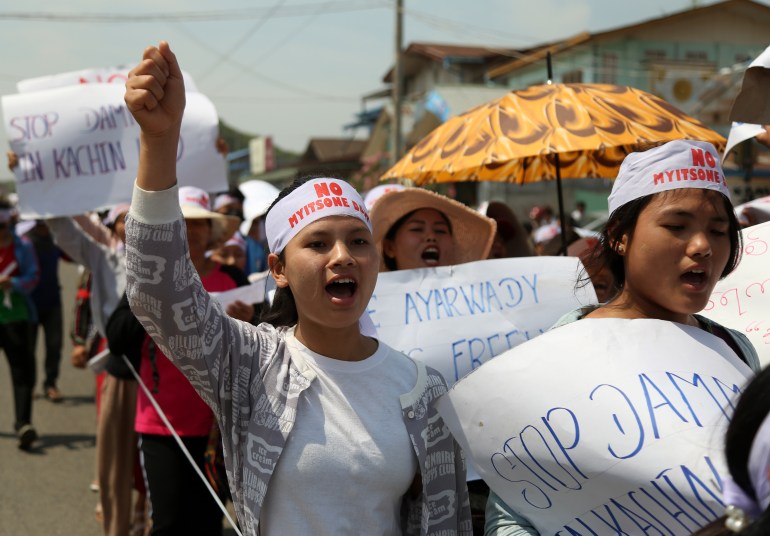
The China-backed Myitsone Dam was cancelled 10 years ago after mass protests [File: Si Thu Mkn/EPA]
But coal’s share of power generation is currently less than 1 percent, 30 times less than the higher-end estimates provided by the NUG and SAC. Sources attributed the discrepancy to efforts by some producers to encourage Myanmar to use more coal.
“The NLD government’s deputy minister [Tun Naing] at the time was being egged on by Japanese, Chinese and Indian coal interests, which no longer would be interested both for policy reasons and because it’s Myanmar post-coup,” an industry source in Yangon told Al Jazeera.
The NUG said it stuck with the overthrown NLD administration’s NDC for COP26 because they felt it had legitimacy from being drawn up by the government elected by the people, according to two senior officials at the NUG’s Ministry of Natural Resources and Environmental Conservation who requested anonymity due to security reasons.
“Considering the legitimacy provided by the Myanmar people to the ousted administration, we [NUG] submitted the NLD government’s NDC to COP26,” said a senior official at the NUG’s Ministry of Natural Resources and Environmental Conservation.
Another senior NUG official said that there had not been enough time for them to redraft the NDC.
“We have received some comments from Indigenous groups and will take their input into account as we revise the NDC,” the official said when asked about the role of ethnic communities in protecting forests.
NUG Deputy Electricity and Energy Minister Maw Htun Aung acknowledged the criticisms and said that the coal policy would be “reconsidered” and the energy master plan reviewed, although it is currently the SAC rather than the NUG which is in the capital, Naypyidaw.
“It does not make sense to focus on coal power. Even China is phasing out coal financing. We do not plan to scale up coal projects, and will work with ethnic communities to draft an energy policy on a federal level,” Maw Htun Aung told Al Jazeera.
According to government estimates last year, electricity in Myanmar comes from 20 gas-fired power stations, 62 hydropower facilities and a single coal-fired plant.
Resource exploitation
In addition to the slowdown in climate-related action and investments, environmental activists and analysts fear that the military will scale up logging, the teak trade, palm oil plantations and the exploitation of natural resources, such as jade, which supported the long-term survival of previous military regimes even under international sanctions.
The generals have also long profited from gem sales, and local media report a gem fair is due to take place in Naypyidaw this month.
Military-appointed agriculture minister Tin Htut Oo in November spoke about expanding palm oil plantations, according to the state-run Global New Light of Myanmar. The official paper said “implementations are underway” to make Tanintharyi Region, a major region in southern Myanmar bordering the Andaman Sea and Thailand, “a big oil pot based on palm oil”.
Mary Callahan, a Myanmar expert at the University of Washington in the United States, says the proposal is “disastrous for fragile ecosystems and endangered species”. Promoting palm oil plantations could lead to a new wave of land confiscation and more deforestation, she told Al Jazeera.
Weeks after seizing power and detaining Aung San Suu Kyi and her allies, Min Aung Hlaing also talked about developing hydropower dams.
As foreign investors withdraw, analysts worry the military will step up its exploitation of natural resources like timber, which helped support previous military regimes in the face of international sanctions [File: Soe Zeya Tun/Reuters]Myanmar has the world’s richest deposits of jade and the industry is dominated by the military [File: Soe Zeya Tun/Reuters]
This has sparked fears that the military might decide to restart the controversial China-backed Myitsone Dam in northern Myanmar, a pet project of former strongman Than Shwe that was halted by then-president Thein Sein in 2011 in the face of significant public protests. The generals have not mentioned Myitsone directly.
“We are very concerned that the military will fall back on old policies like large-scale hydropower, which could spell disaster for the country’s two major rivers – the Ayeyarwady and Thanlwin – the last two remaining large free-flowing rivers in tropical Asia,” said a senior staff member at an environmental NGO working on Myanmar, who declined to be named for security reasons.
Ethnic communities along the borders, coasts and hilly regions are also concerned about the climate risks.
“Of course we are worried about climate change. We are working on forest management and climate issues,” said a senior official of an ethnic armed group in northern Myanmar, who declined to be identified due to the sensitivity of the matter. Even though most of the territories controlled by his group are mountainous and protected from flooding, other climate-induced disasters such as cyclones, drought and landslides remain a threat to the local population. Since the coup, his group, which has long sought autonomy, has renewed fighting against the armed forces.
“Because of the coup and political crisis, it has become more difficult to address environmental challenges. For one, more and more international investors and partners have withdrawn from Burma,” he said. A key reason, he added, is that “the Burmese military leader will rely on natural resources to resolve their finances problem. Not only this junta but also successive regimes in the previous State Peace and Development Council [SPDC] era.”
The SPDC was the official name for the military government that seized power in 1988.
“Forests in the border areas controlled by ethnic groups are more secure than those in government-held regions,” the staff member from the environmental NGO said. “To help protect these forests, we need neighbouring countries and economic blocs like ASEAN and the EU to be on high alert for illegally-traded timber. Tackling demand is key.”
Still, in his written remarks submitted to COP26, the military-appointed Natural Resources and Environmental Conservation Minister Khin Maung Yi pledged to achieve 50 percent net emissions reductions by 2030 “if adequate international assistance is received”.
“Similarly, by 2030, the share of new renewable energy targets (solar, wind) will be increased from 2000MW to 3070MW,” Khin Maung Yi wrote.
Demonstrators flash the three-finger salute and burn a flag during an anti-coup protest in Yangon on November 24. Ten months since the coup, there remains strong resistance to the generals [Stringer/EPA]
But as long as the political crisis continues its downward spiral, neither the foreign assistance nor the energy investments on which the military is banking — with the possible exception of China — is likely to be forthcoming, according to diplomats and investors in Yangon.
Experts say environmental exploitation risks pushing more into poverty and increasing food insecurity, but as the generals focus on crushing any resistance to their rule, few have any confidence they will have the will to address Myanmar’s impending climate nightmare.



:quality(70)/cloudfront-us-east-1.images.arcpublishing.com/adn/UZLAXLHRMZHONG3HDQTRNCKHS4.jpg)
:quality(70)/cloudfront-us-east-1.images.arcpublishing.com/adn/MO3Y2CPTTFG7PBU6DZZEZH2L2A.jpg)
:quality(70)/arc-anglerfish-arc2-prod-adn.s3.amazonaws.com/public/7DTBL4XHFFB4RHANXP4C6C7D4E)
:quality(70)/cloudfront-us-east-1.images.arcpublishing.com/adn/N7CDOLTFHBBPFLV3TMMIXMCCLU.JPG)
:quality(70)/cloudfront-us-east-1.images.arcpublishing.com/adn/TTVA7OLTYJDVXCJ4UO73TEGZLI.jpg)
:quality(70)/cloudfront-us-east-1.images.arcpublishing.com/adn/JFD3UGB3NVHPBIMGMFXT56BQ5E.JPG)

 The China-backed Myitsone Dam was cancelled 10 years ago after mass protests [File: Si Thu Mkn/EPA]
 As foreign investors withdraw, analysts worry the military will step up its exploitation of natural resources like timber, which helped support previous military regimes in the face of international sanctions [File: Soe Zeya Tun/Reuters]
 Myanmar has the world’s richest deposits of jade and the industry is dominated by the military [File: Soe Zeya Tun/Reuters]
 Demonstrators flash the three-finger salute and burn a flag during an anti-coup protest in Yangon on November 24. Ten months since the coup, there remains strong resistance to the generals [Stringer/EPA]